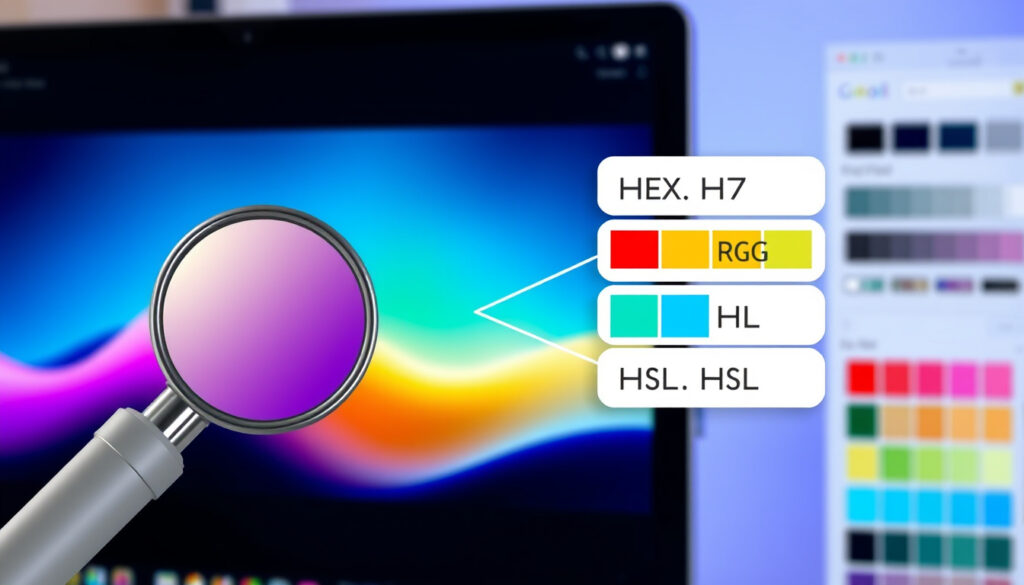
Color Picker From Image – Extract HEX, RGB & HSL Instantly
Ever grabbed a screenshot and wished you could instantly know the exact color code of that perfect shade? Picking colors from images doesn’t have to be guesswork — with a free online color picker from image, you can extract HEX, RGB, or HSL codes in seconds by simply uploading a file or pasting a URL, and the following covers the best tools, step-by-step methods, and what to watch for when matching colors across different image formats.
Number of colors in a 24-bit image: 16,777,216 ·
Common color models used online: HEX, RGB, HSL ·
Average HEX code length: 7 characters (including #) ·
Number of free online color picker tools: >50 ·
Year first browser-based color picker appeared: Early 2010s
Quick snapshot
- HEX and RGB are standard web color models (HTML Color Codes (independent color reference))
- Online color pickers read pixel colors accurately (ImageToolo (web color tool developer))
- Most tools support HEX, RGB, HSL, HSB, and CMYK (RedKetchup (image processing utility))
- How color pickers handle anti-aliased pixels (ColorPickerFromImage (browser-based tool))
- Consistency of color extraction across different browsers (ImageColorPicker (online color tool))
- Browser-based color pickers became mainstream around 2010–2015 (Figma (design platform))
- EyeDropper API support in Chrome & Edge added in 2021 (PickColorOnline (API-based picker))
- Better support for picking colors from video frames (Skylum (design software maker))
- Integration of AI-assisted palette generation from images (HTML Color Codes (color resource))
Four tools, one pattern: dedicated color picker sites focus on immediate extraction with no account required, while design platforms like Figma offer deeper editing but demand signup for saving palettes.
| Tool | Input Methods | Output Formats | Extra Features |
|---|---|---|---|
| ImageColorPicker | Upload, URL, clipboard | HEX, RGB, HSL, HSV | Zoomed pixel view |
| ColorPickerFromImage | Upload | HEX, RGB, HSL | Auto palette (3–24 colors), no server upload |
| Figma Color Picker | Upload (PNG, JPEG, GIF) | HEX, RGB, HSB, HSL | Drag swatches, integrated design workflow |
| RedKetchup | Upload, drag-and-drop, clipboard | HEX, RGB, HSL, HSV, CMYK | Supports 9 image formats including SVG |
| HTML Color Codes | Upload | HEX, RGB, HSL, OKLCH | Palette export, educational resources |
| PineTools | Upload, URL | HEX, RGB, HSV, HSL | Simple interface, third-party libraries |
| ImageToolo | Upload | HEX, RGB, RGBA, HSL, HSLA, CMYK | Pixel-perfect accuracy, in-browser |
| PickColorOnline | EyeDropper API (screen) | HEX, RGB | No upload needed, works on PDFs |
Dedicated color picker sites prioritize speed and zero friction, while platform tools like Figma lock saving palettes behind an account. For one-off extraction, the independent tools win. For ongoing design work, Figma’s ecosystem justifies the extra step.
How do I pick a color from an image?
Uploading an image to a color picker
The most straightforward method is uploading your image file directly to a color picker website. Tools like ImageColorPicker allow you to upload any JPEG, PNG, or WEBP image, then click on any pixel to see its color code. The page displays the exact HEX, RGB, and HSL values for the pixel you select.
ImageColorPicker provides a zoomed pixel view for precise color selection.
Using drag and drop
Several tools, including RedKetchup, support drag-and-drop. You simply drag the image file from your computer directly into the browser window. This method supports formats like PNG, JPEG, WEBP, HEIC, GIF, ICO, TIFF, BMP, and even SVG vector images — making it one of the most format-flexible options available.
Figma’s color picker integrates seamlessly into the design workflow.
Pasting from clipboard
If you have a screenshot or copied image, some color pickers accept clipboard pasting. ImageColorPicker and RedKetchup both support Ctrl+V to paste an image directly. This is especially useful when you’ve just taken a screenshot and want to grab a color without saving the file first.
Choosing a color by clicking
Once the image loads in the tool, you click on the pixel whose color you want. Most tools provide a magnified view of the surrounding pixels for precision. ColorPickerFromImage and ImageColorPicker both include zoomed-in previews so you can target a single pixel even in detailed areas.
A designer picking a brand color from a logo screenshot needs pixel-level accuracy. Without a zoomed view, anti-aliased edges can produce a color that looks right but doesn’t match the actual brand HEX value — a problem that causes mismatched headers and buttons across a website.
What is the best free color picker from image tool?
Comparison of imagecolorpicker.com, Figma, RedKetchup, HTML Color Codes, PineTools
Each tool has strengths depending on what you need. The table above compares seven major options. Here’s the editorial breakdown:
- ImageColorPicker — best for quick one-off extractions with zoom precision.
- Figma — best for designers who want to save and organize palettes within a professional workflow.
- RedKetchup — best for format flexibility, supporting SVG and HEIC along with standard formats.
- HTML Color Codes — best for learning, with tutorials and OKLCH color space support.
- PineTools — best for simplicity: upload, click, copy — no frills.
Key features: color formats, ease of use, no signup
All seven tools are free and require no account creation. The output formats vary: basic tools offer HEX and RGB, while advanced ones like ImageToolo also support RGBA, HSLA, and CMYK. HTML Color Codes even includes OKLCH, a modern perceptually-uniform color space.
Pros and cons of each tool
Upsides
- All tools free with no signup
- Multiple input methods: upload, URL, clipboard, drag-and-drop
- Broad format support (JPEG, PNG, WEBP, GIF, SVG)
- Instant pixel-level accuracy
- RedKetchup handles 9 image formats
- Figma integrates with professional design flow
Downsides
- Color names from tools are approximations, not exact
- Figma requires account for saving palettes
- No mobile-optimized alternatives discussed here
- Some tools (PineTools) use third-party libraries — potential privacy concern
- No tool explains how anti-aliasing affects readings
The pattern: dedicated pickers are faster for single-use, but platforms like Figma offer a richer workflow at the cost of an account requirement. For most casual users, a dedicated tool is sufficient.
How to get HEX color from image?
Why HEX is popular for web design
HEX codes are the standard for CSS colors because they are compact, reliable, and universally supported across browsers. A HEX code starts with # followed by six hexadecimal digits (e.g., #FF5733), representing red, green, and blue values. Most color pickers display HEX by default — it’s the format you’ll use most when writing CSS or HTML.
Steps to extract HEX code
- Open a color picker tool like ImageColorPicker.
- Upload or paste your image.
- Click the pixel you want — the HEX value appears instantly.
- Copy the code (e.g.,
#2A5C8E) and paste it into your CSS file.
Example of converting RGB to HEX
If a tool only shows RGB, you can convert manually. RGB rgb(42, 92, 142) converts to HEX #2A5C8E. Each pair of HEX digits corresponds to one channel: 2A = 42 (red), 5C = 92 (green), 8E = 142 (blue). Most color pickers display both formats side by side, but knowing the conversion helps when working with design specs that use different models.
What this means: if your design tool gives you RGB but your CSS needs HEX, you can either use a converter or simply pick a tool that outputs both. Every major tool in this guide displays both formats.
Can I pick a color from an image without uploading it?
Using browser extensions
Browser extensions like ColorPick Eyedropper or similar Chrome extensions let you pick colors from any webpage without uploading anything. These extensions inject an eyedropper icon into your browser toolbar. Click it, then hover over any element on the page to see its HEX or RGB value. No image upload required — the extension reads colors directly from the rendered pixels.
Pasting from clipboard
As mentioned earlier, tools like ImageColorPicker and RedKetchup accept clipboard pasting. Take a screenshot (PrtScn on Windows or Cmd+Shift+3 on macOS), then paste it directly into the tool (Ctrl+V or Cmd+V). This method is faster than saving and uploading a file, especially for quick screen captures.
Entering image URL
Some tools, including PineTools and ImageColorPicker, allow you to enter a direct image URL. If the image is hosted online (e.g., on a portfolio site or CDN), paste the URL and the tool loads it remotely. This avoids downloading the file to your computer — useful when working with shared design assets or stock photos.
The catch: URL-based loading works only if the image is publicly accessible and the server allows cross-origin requests. Private or protected images may fail to load in the tool.
What color formats can I extract from an image?
HEX
Standard for web design. Represented as #RRGGBB or shorthand #RGB. Every tool supports this format. Example: #FF5733.
RGB
Red, green, blue values from 0–255. Used in CSS via rgb(255, 87, 51). Supported by all tools listed.
HSL
Hue (0–360°), saturation (0–100%), lightness (0–100%). Preferred by designers for adjusting color relationships. Supported by ImageColorPicker, RedKetchup, Figma, and others.
HSB / HSV
Hue, saturation, brightness/value. Similar to HSL but with brightness as a separate channel. ImageColorPicker and Figma output HSB; RedKetchup outputs HSV.
CMYK
Cyan, magenta, yellow, key (black). Used for print design. RedKetchup and ImageToolo support CMYK extraction — useful if you’re designing materials for printing.
How to get the exact color name from an image?
Some tools attempt to match extracted codes to named colors (e.g., “Coral” for #FF7F50). These are approximate and should not be relied upon for branding. As noted in the confirmed facts, ColorPickerFromImage generates color palettes but does not guarantee exact names.
JPEG compression introduces color shifts in adjacent pixels due to lossy encoding. A pixel that appears #F5F5F5 in the original PNG might read as #F2F2F2 after JPEG compression. Always extract colors from uncompressed or lossless formats (PNG, TIFF, BMP) for brand-critical work.
The trade-off: more color models mean more flexibility, but also more complexity. Most web projects need only HEX and RGB. Print projects require CMYK. If you’re a generalist designer, stick with tools that output all three — RedKetchup and ImageToolo cover the full spectrum.
How to achieve consistent color extraction across JPEG, PNG, and SVG
Start with lossless formats. For logos, icons, and UI elements, use PNG or SVG — these preserve exact pixel values. JPEG artifacts cause nearby pixels to shift by 1–3 color values, which is enough to break a brand guideline that demands #1E3A5F.
When extracting from SVG, ensure the file is rendered as a raster by the tool. Most SVG files contain vector data, and the color picker displays the rendered pixel color — which should match the fill attribute in the SVG source if no transparency or blending is applied.
For critical color matching, extract from at least three different pixels in the same area and average the results. Tools like HTML Color Codes also generate palette variations that help you spot outliers.
The implication: using lossless sources is essential for brand consistency.
Can I pick a color from a video frame?
Most online color pickers do not support video uploads directly. However, a workaround exists: pause the video at the desired frame, take a screenshot, and paste it into a clipboard-compatible tool like ImageColorPicker or RedKetchup. PickColorOnline can also pick colors from any portion of your screen, including a paused video player, using the EyeDropper API.
The pattern: while direct video support is absent, the screenshot+paste method takes about 15 seconds and works reliably across all modern browsers.
Related reading: ColorPickerFromImage · ImageColorPicker
For a comprehensive overview of the top options available, check out this guide to the best free online color picker tools for 2025.
Frequently asked questions
How do I pick a color from an image without a mouse?
Use keyboard shortcuts. On PickColorOnline, press i after clicking the extension icon to activate the eyedropper. For other tools, Tab through the interface to reach the upload button, then use Arrow keys to navigate the image if the tool supports keyboard pixel selection.
Can I use a color picker from image on my phone?
Yes. Most dedicated color picker websites are mobile-responsive. Open the site in your mobile browser, upload a photo from your gallery, and tap the pixel you want. PickColorOnline and ImageColorPicker work well on iOS and Android.
What is the difference between HEX and RGB?
HEX is a shorthand for RGB values in hexadecimal notation. #FF0000 (HEX) equals rgb(255, 0, 0) (RGB). Both represent the same color — they’re just different syntaxes. HEX is more compact; RGB is more human-readable for adjusting individual channels.
Is it possible to pick a color from a PDF?
Yes, with a screen-based tool like PickColorOnline. Open the PDF, zoom to the area with the color, activate the eyedropper, and click. For embedded images within PDFs, extract the image first using a PDF tool, then upload to a color picker.
How accurate are color pickers when the image is compressed (JPEG)?
Less accurate than with lossless formats. JPEG compression creates block-level color averaging, so a pixel that was #F5F5F5 may read as #F2F2F2. For precise color matching, use PNG or BMP source files.
Do I need to install anything to use an online color picker?
No. All tools listed in this guide run entirely in the browser. No software download or signup required. Browser extensions are optional but can speed up screen picking without needing to upload a file.
Can I pick multiple colors from one image at once?
Some tools offer auto-palette generation. ColorPickerFromImage detects 3–24 prominent colors from an uploaded image and displays them as a palette. Figma also generates color schemes from gallery images.
For most users, a free online color picker provides instant, accurate color codes without any installation.
Related reading
More related posts
 Sutton Foster Movies and TV Shows: Full Credits List
 When Does Avatar 3 Come Out? Release & Streaming Dates
 Buffy the Vampire Slayer: Cancellation, LGBTQ, Deaths, and More
 Tiger Woods Net Worth (2026): How He Built a $1.5 Billion Fortune
 16 Oz to Cups – Reliable Conversion Guide
 Square Root of 3: Value, Methods, and Proof
 Knicks vs Spurs 2026 Finals: Full Timeline & Scores
 Real Madrid vs. Athletic Bilbao: H2H, Results