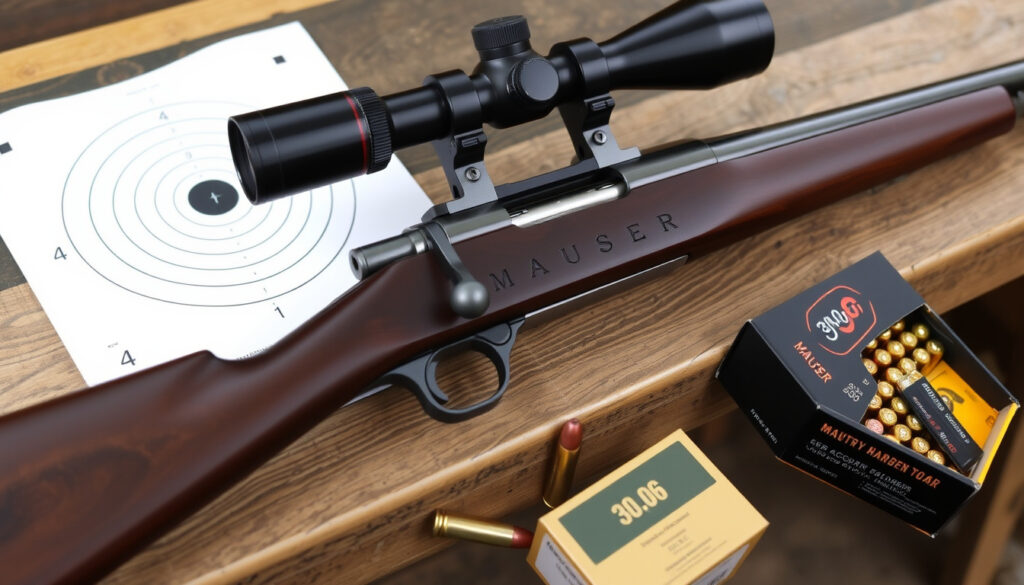
Mauser 30-06: Is It Real, Accurate, and Better than .308?
If you’ve heard someone mention a “Mauser 30-06” and wondered whether it’s a real factory rifle or a gunsmith’s Frankenstein, you’re not alone. The German Mauser 98 action and the American .30-06 Springfield cartridge have an intertwined history that produces a legitimate — if misunderstood — hybrid platform.
Cartridge: .30-06 Springfield (7.62×63mm) ·
Rifle Origin: Mauser 98 (German design, 1898) ·
Chambering Availability: Original Mauser 98 in 8mm Mauser; aftermarket rechambering or commercial FN Mauser in .30-06 ·
NATO Equivalent: 7.62×51mm NATO (similar but not interchangeable) ·
Best Known Variant: FN Mauser .30-06 (commercial)
Quick snapshot
- Mauser 98 action can be rechambered to .30-06 (American Rifleman)
- FN Mauser commercial models in .30-06 exist and are sold by specialist riflemakers (Griffin & Howe)
- The .30-06 cartridge was developed by the U.S. military in 1906, not by Mauser (Wikipedia)
- Total production numbers for Mauser action rifles originally sold in .30-06 are not documented in public records (Wikipedia (Mauser 98))
- Exact accuracy expectation for any given Mauser 30-06 build varies by barrel, bedding, and ammo — no single standard exists (Ron Spomer Outdoors)
- Survival rate of original military 8mm barrels re-bored to .30-06 is unknown due to informal gunsmith conversions (American Rifleman (gunsmith conversion guide))
- 1898: Mauser 98 design patented, chambered in 7.92×57mm (8mm Mauser) (Wikipedia)
- 1906: .30-06 Springfield adopted by U.S. military (Wikipedia)
- Post-WWII: FN (Fabrique Nationale) produced commercial Mauser 98 rifles in .30-06 for the American hunting market (Wikipedia)
- Interest in military-surplus-to-custom builds drives continued aftermarket barrel and stock support for Mauser actions (Boyds Gunstocks)
- Modern manufacturers like Zastava and Howa offer new-production Mauser-type actions in .30-06 (Boyds Gunstocks)
The table below summarizes the essential specifications of the Mauser 30-06 hybrid.
| Label | Value |
|---|---|
| Cartridge Type | .30-06 Springfield |
| Action Type | Mauser 98 bolt-action |
| Original Mauser Chambering | 8×57mm Mauser |
| Modern FN Mauser Chambering | .30-06 Springfield |
| Common Use | Hunting, target shooting |
| Magazine Capacity | 5 rounds |
Is There Such a Thing as a Mauser 30-06?
The Mauser 98 and the .30-06 Cartridge
- The Mauser 98 was originally designed by Paul Mauser in 1898 and chambered in 7.92×57mm (8mm Mauser), not .30-06 (Wikipedia (firearms history authority)).
- The .30-06 Springfield cartridge was adopted by the U.S. military in 1906, nearly a decade after the Mauser action — the two were never paired at the factory level by Mauser (Wikipedia).
- Because the Mauser 98 is a controlled-feed action with a full-length receiver, aftermarket gunsmiths have successfully rebarreled or rechambered surplus rifles to .30-06 for decades (Facebook firearms enthusiast group).
FN Mauser Commercial Models
- Belgian manufacturer Fabrique Nationale (FN) produced commercial Mauser 98 rifles chambered in .30-06 for the American hunting market starting in the 1950s (Mauser.com).
- Griffin & Howe, a premium custom rifle shop, lists FN Mauser .30-06 rifles for sale with specs on barrel condition and stock fit (Griffin & Howe (custom rifle specialists)).
Mauser 30-06 vs Original 8mm Mauser
- The 8mm Mauser (7.92×57mm) fires a .323-inch bullet; the .30-06 fires a .308-inch bullet — they are not interchangeable (Wikipedia).
- A Mauser originally built in 8mm must have its barrel bored or replaced to safely fire .30-06, a process that requires a qualified gunsmith (American Rifleman (shooting publication)).
The implication: a “Mauser 30-06” is almost always a hybrid — either a post-war commercial production by FN or a gunsmith conversion. It’s not a single model you’ll find in a catalog from 1910.
Is a Mauser 30-06 an Accurate Rifle?
Factors Affecting Accuracy
- The Mauser 98 action is renowned for its strength and controlled feeding, but accuracy depends on barrel quality, bedding, crown, and ammunition (Wikipedia (Mauser 98 article, citing ballistics experts)).
- Military-surplus barrels were built for reliability and rough handling, not match-grade precision; rifles chambered in .30-06 via conversion will reflect the condition of the specific barrel installed.
“Custom Mauser 98 rifles built with quality aftermarket barrels and bedding frequently achieve 1 to 2 MOA (minute of angle) groups at 100 yards — comparable to many modern hunting rifles.”
Typical Accuracy of Mauser Action Rifles
- Custom Mauser 98 rifles built with quality aftermarket barrels and bedding frequently achieve 1 to 2 MOA groups at 100 yards — comparable to many modern hunting rifles (Ron Spomer Outdoors).
- No official accuracy specification exists from Mauser for .30-06 chamberings, because Mauser never produced a .30-06 factory model (Mauser.com).
Aftermarket Barrel Upgrades
- Premium barrel manufacturers like Lothar Walther and Shilen offer .30-06 barrels pre-threaded for Mauser 98 actions, allowing precision-minded shooters to upgrade the original tube (Lothar Walther (precision barrels)).
- A well-bedded Mauser action with a quality barrel can match or exceed the accuracy of factory .30-06 rifles from Remington or Winchester.
A Mauser 30-06’s accuracy is not determined by the action but by the barrel and bedding. An owner who invests in a top-tier barrel and proper glass-bedding gets a 1-MOA hunting rig; an owner who shoots through an old surplus tube gets 3-4 MOA. The action itself is a solid foundation, not a guarantee.
The trade-off: a custom Mauser 30-06 can outshoot many modern off-the-shelf rifles, but only after spending several hundred dollars on barrel work.
What Is the NATO Equivalent of 30-06?
7.62×51mm NATO vs .30-06 Springfield
- The 7.62×51mm NATO cartridge is the closest military equivalent to the .30-06 Springfield, but they are not identical (Wikipedia (cartridge reference)).
- The .30-06 case length is 2.494 inches; the 7.62 NATO case is 2.015 inches (Ron Spomer Outdoors).
- Because the .30-06 is a long-action cartridge, the 7.62 NATO (a short-action cartridge) fits physically inside a .30-06 chamber but not vice versa.
Pressure Differences and Interchangeability
- The .30-06 is rated at a maximum average pressure of 60,000 psi per SAAMI, while 7.62 NATO is rated to a different pressure standard (about 50,000 psi in some loadings) (SAAMI (ammunition industry standards)).
- Firing 7.62 NATO ammunition in a .30-06 chamber is generally considered safe, but accuracy may suffer due to the shorter case not seating the bullet properly (YouTube / Head-to-Head 308 vs 30-06).
- Firing .30-06 ammunition in a 7.62 NATO chamber is dangerous because the longer .30-06 case will not fit and may rupture the chamber.
Chamber Compatibility
- Rifles explicitly marked .30-06 Springfield should only be fed .30-06 or (with care) 7.62 NATO ammunition.
- Rifles marked 7.62 NATO or .308 Winchester should never be used with .30-06 ammunition due to excessive chamber pressure risks.
The catch: the .30-06 and 7.62 NATO look similar but differ in case length and pressure. Treat them as separate ammunition categories to avoid catastrophic failures.
A shooter who owns a Mauser 30-06 should buy only .30-06 ammunition. Using surplus 7.62 NATO is safe but inaccurate; using .223 Remington or any other short cartridge in the long action is a dangerous game.
Does a Mauser 30-06 Break Down?
Takedown Models vs Standard Models
- Standard Mauser 98 rifles are one-piece stock-and-barrel designs that do not break down without tools (Wikipedia).
- A rare “Mauser 98 Takedown” model exists, featuring a barrel that unscrews from the receiver for compact storage, but it is not common and was never produced in .30-06 factory configuration.
How to Disassemble a Mauser 98 for Transport
- Ensure the rifle is unloaded.
- Remove the bolt.
- Remove the magazine follower and spring.
- Separate the barreled action from the stock.
Basic field stripping a standard Mauser 98 removes the bolt, follower, and magazine spring; the rifle becomes two pieces — barreled action and stock — in about 30 seconds (YouTube disassembly demonstration).
Commercial Takedown Mauser Variants
- Some custom Mauser builders offer takedown rifles for African or Alaskan hunters who need a rifle that fits in a duffle bag.
- Griffin & Howe’s FN Mauser .30-06 is a standard solid stock, not a takedown, but custom shops can convert a standard Mauser into a takedown for an added cost.
Why this matters: if portability is critical (backpack hunting, fly-in trips), a takedown Mauser 30-06 is possible but expensive. Most owners settle for the simple action/stock separation of the standard model.
Is a 30-06 Better Than a 308?
Ballistics Comparison
- The .30-06 typically produces higher velocity and energy than the .308 Winchester because of its larger case capacity (MeatEater (hunting and ballistics resource)).
- Ron Spomer Outdoors notes that 180-grain loads in .30-06 and .308 deliver “remarkably similar” factory velocities — with the .30-06 roughly 3% faster.
- The .308 is a short-action cartridge (max overall length 2.810 inches) while .30-06 is a long-action cartridge (3.340 inches).
“The .30-06 is offered in more heavy-bullet ammunition options than .308 Win. at MidwayUSA, citing 36 varieties of .30-06 cartridges loaded with 180-grain bullets versus 16 options for .308 Win.”
Recoil and Energy
- A 165-grain .308 load produces about 17 ft-lbs of recoil energy; a comparable .30-06 load produces about 20 ft-lbs (MeatEater (citing Chuck Hawks recoil table)).
- The .30-06’s 3% velocity gain for 180-grain bullets costs roughly 16% more felt recoil (Ron Spomer Outdoors).
Hunting and Tactical Applications
- Both cartridges are effective for medium to large game. The .30-06 offers more heavy-bullet variety: MeatEater counted 36 factory loads with 180-grain bullets for .30-06 vs 16 for .308 Winchester.
- The .308 Winchester is preferred for shorter-action rifles and suppressed builds because of its shorter case and lower gas volume.
Ammo Availability and Cost
- .30-06 ammunition is widely available in the U.S. but slightly less abundant than .308, which is the standard NATO round and used by many law enforcement agencies (Remington (ammunition manufacturer)).
- In terms of cost, .308 ammunition is generally 10-20% cheaper per round than .30-06 for comparable grades.
For a side-by-side comparison of the .30-06 and .308, see the table below.
| Dimension | .30-06 Springfield | .308 Winchester |
|---|---|---|
| Case length | 2.494 inches | 2.015 inches |
| Max overall length | 3.340 inches | 2.810 inches |
| Recoil energy (165-gr) | ~20 ft-lbs | ~17 ft-lbs |
| 180-gr bullet options (Midway) | 36 loads | 16 loads |
| Typical action length | Long action | Short action |
Upsides of .30-06
- Higher velocity and energy
- Wider selection of heavy bullet loads
- Proven on elk and larger game
Downsides of .30-06
- More felt recoil
- Requires long-action receiver
- Higher ammunition cost
The trade-off: the .30-06 gives you more velocity and broader bullet selection but kicks harder and requires a longer action. For a Mauser 98, which is a long action by design, the .30-06 is a natural fit — and the .308 would look like a short cartridge inside the same receiver.
Summary
The Mauser 30-06 is real but niche: a hybrid born from a legendary action and a classic American cartridge, it lives primarily as an FN commercial model or a custom gunsmith conversion. Its accuracy depends on the barrel and bedding investment, not the action itself. For American hunters who already have a Mauser 98 and prefer the .30-06’s heavier payload options over the .308’s lower recoil, the decision is clear: invest in a quality barrel and bedding, and you’ll own a rifle with the soul of a 19th-century design and the punch of a 20th-century cartridge. Or choose a modern .308 if you want a lighter, shorter platform with cheaper ammo. Either way, the Mauser 30-06 is a reminder that great engineering transcends its original cartridge.
Frequently asked questions
What is the price of a Mauser 30-06?
Prices vary widely. A custom FN Mauser from Griffin & Howe can cost $2,500–$4,000. A surplus military Mauser 98 converted to .30-06 by a local gunsmith may be found for $500–$1,200 depending on barrel quality and stock condition.
Can I use .308 ammunition in a Mauser 30-06?
Yes, .308 Winchester (or 7.62 NATO) cartridges can be safely fired in a .30-06 chamber. However, accuracy may suffer because the shorter .308 case will not seat the bullet at the proper depth for the longer throat. For best performance, use .30-06 ammunition.
Is a Mauser 30-06 suitable for hunting elk?
Absolutely. The .30-06 cartridge is one of the most proven choices for elk hunting, and a well-built Mauser 30-06 with a quality barrel is more than capable of taking elk at ranges out to 300 yards with proper bullet selection (MeatEater).
How does a Mauser 30-06 compare to a modern bolt-action rifle?
Modern rifles like the Tikka T3x or Ruger American offer lighter weight, better factory triggers, and easier scope mounting. The Mauser 30-06 wins on action strength, controlled-feed reliability, and historical appeal. For a custom project, the Mauser can match modern accuracy.
What aftermarket stocks are available for Mauser 30-06?
Several manufacturers produce synthetic and laminate stocks inletted for the Mauser 98 action, including Boyds Gunstocks, McMillan, and Bell & Carlson. These allow bedding improvements and weight reduction (Boyds (stock manufacturer)).
Is the Mauser 30-06 still produced today?
No major manufacturer produces a “Mauser 30-06” as a standard catalog item today. FN stopped commercial production decades ago. However, custom shops and small-scale builders still produce Mauser-action rifles in .30-06 on a made-to-order basis.
What is the difference between a Mauser 30-06 and a Mauser 98?
A Mauser 98 is the action design originally chambered in 8mm Mauser. A “Mauser 30-06” refers to a Mauser 98 action that has been factory- or custom-converted to accept the .30-06 Springfield cartridge. The action itself is the same; the barrel, bolt face, and magazine are adapted for the longer .30-06 round.
More related posts
 Mercury Retrograde 2025 Dates: Complete Guide
 How Old Is Goldie Hawn? Age, Height, Children & More
 How to Scan With iPhone: Documents, QR Codes, and PDFs
 Carolina Panthers Depth Chart 2026: Starters & Battles
 How to Ice Skate for Beginners: Step-by-Step Guide
 AMD Radeon RX 9070 XT Review: Specs & Nvidia Comparison
 Yes or No Generator: Best for Quick Random Decisions
 Resident Evil Movies in Order: Complete Watch Guide