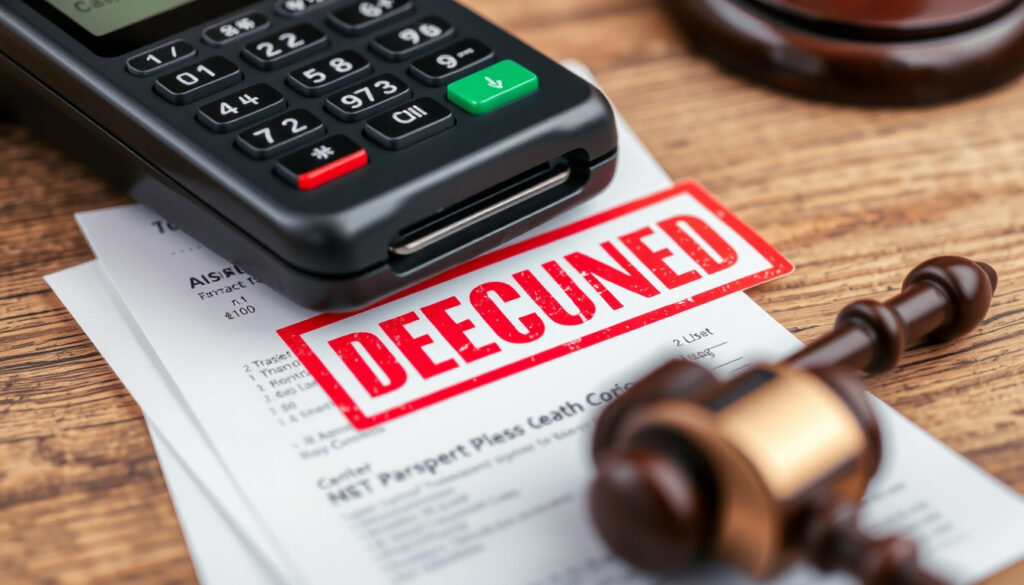
What Is a Chargeback? Process, Costs, and Legal Risks
You buy something online, it doesn’t arrive, and the seller stops answering emails — that’s when the word “chargeback” suddenly matters. A chargeback is a formal reversal of funds initiated through your bank, a right backed by consumer protection rules like the Fair Credit Billing Act.
Average cost per chargeback to merchants: $128 (Mastercard, 2025) ·
Chargeback reason categories: Fraud, billing error, non-receipt, quality issues ·
Time window to file a chargeback: Usually 120 days from purchase (up to 540 days per Visa) ·
Consumer success rate: Approximately 60-80% when dispute is valid (industry estimates) ·
Chargeback fraud as a federal crime: Under 18 U.S.C. § 1343 (wire fraud) if exceeds $5,000
Quick snapshot
- A chargeback is a transaction reversal initiated by a cardholder’s bank (Stripe, payment processor)
- Typically used to dispute fraudulent, unauthorized, or erroneous charges (Equifax, credit bureau)
- Involves a formal process with fees and potential arbitration (Stripe, payment processor)
- Guaranteed refund for valid disputes under card network rules (Consumer Financial Protection Bureau, US regulator)
- Backed by consumer protection laws (e.g., FCBA in US, CCA in UK) (Consumer Financial Protection Bureau, US regulator)
- Provides recourse when merchant refuses or is unresponsive (Consumer Financial Protection Bureau, US regulator)
- Merchant pays chargeback fees ($15-$100+ per incident) (Chargeflow, merchant chargeback software)
- Loss of product or service revenue (TrueLayer, payment infrastructure provider)
- High chargeback ratios can lead to account termination (Stripe, payment processor)
- Refund: voluntary by merchant, no fees, preserves relationship (SEON, fraud prevention platform)
- Chargeback: forced by bank, costly for merchant, may damage trust (SEON, fraud prevention platform)
- Consumers should always attempt refund first (Consumer Financial Protection Bureau, US regulator)
The table below summarizes key chargeback statistics — the system is designed to protect consumers, but merchants carry most of the financial weight.
| Fact | Detail |
|---|---|
| Definition | A chargeback is the reversal of a card payment after a cardholder disputes a transaction with their issuing bank (Equifax, credit bureau). |
| Typical timeline | 45 to 120 days from transaction date (maximum up to 540 days per Visa) (Financial Ombudsman Service, UK dispute resolution body). |
| Average cost to merchant | $128 per chargeback (Mastercard, 2025) including fees and internal costs (Mastercard, global card network). |
| Most common reason | Unauthorized/fraudulent transaction (approx. 50% of cases) (Equifax, credit bureau). |
| Consumer success rate | Approximately 60–80% for legitimate disputes (industry estimates). |
| Legal risk for abuse | Chargeback fraud can lead to federal wire fraud charges (18 U.S.C. § 1343) if over $5,000 (Cornell Law School, legal research institute). |
How does a chargeback work?
The chargeback process involves four participants: the cardholder, the merchant, the card-issuing bank, and the merchant’s acquiring bank. Each step is governed by card network rules that give consumers a strong safety net — but with costs that hit merchants hard.
Step 1: Cardholder disputes a transaction with their bank
- The cardholder contacts their issuing bank by phone, mail, or online portal to flag a transaction as fraudulent, unauthorized, or incorrect (Equifax, credit bureau).
- The bank reviews the dispute and may issue a provisional credit while investigating.
Step 2: Bank investigates and notifies the merchant’s acquiring bank
- The issuer sends the dispute through the card network (Visa, Mastercard, etc.) to the merchant’s acquiring bank.
- The merchant receives a chargeback notification and must respond within a strict window — typically 7 to 30 days (Justt, chargeback management platform).
Step 3: Merchant can accept or fight the chargeback (representment)
- If the merchant believes the transaction was valid, they can submit evidence — such as signed receipts, delivery confirmation, or communication records — to contest the chargeback (Justt, chargeback management platform).
- If the merchant does nothing, the chargeback is automatically lost, and the funds are deducted from the merchant’s account.
Step 4: Card network makes final decision or arbitration
- If the merchant’s evidence successfully overturns the chargeback, the funds are returned — but the merchant still pays a chargeback fee in most cases.
- If the dispute escalates, the card network may step in for arbitration, a process that can take months and carries additional fees (Justt, chargeback management platform).
Consumers have roughly 120 days from the purchase to file a chargeback — but for goods or services never delivered, the clock may start from the expected delivery date (Financial Ombudsman Service, UK dispute resolution body). This means a buyer can file months after the seller disappeared.
Why would someone do a chargeback?
People file chargebacks for a handful of reasons. Some are valid protections; others stretch the system into what the industry calls “friendly fraud.”
Fraudulent transactions (stolen card, unauthorized use)
- Fraud is the most common reason, accounting for roughly half of all chargebacks. A cardholder sees a charge they never made and disputes it.
- Card network rules guarantee the cardholder is not liable for unauthorized transactions once reported (Equifax, credit bureau).
Billing errors (duplicate charges, wrong amount)
- A customer is charged twice for the same item, or the final price doesn’t match what was agreed. The bank can reverse the extra amount.
Item not received or defective
- The product never arrived, or it arrived broken. Under the UK Financial Ombudsman rules, the 120-day chargeback window can start when the goods were supposed to have been delivered (Financial Ombudsman Service, UK dispute resolution body).
Service not rendered as described
- A vacation rental is nothing like the photos, or a subscription service stops working. Chargebacks offer a path when the merchant won’t make it right.
A growing share of chargebacks are “friendly fraud” — consumers who knowingly file false disputes to get something for free. Estimates suggest friendly fraud may account for 20-40% of all chargebacks, though exact figures are hard to pin down because issuers don’t always flag intent. The burden of proof falls on the merchant, even when the customer is acting in bad faith.
What this means: The same mechanism that protects a fraud victim can be weaponized by an unhappy customer. Merchants are left fighting an uphill battle to prove the transaction was legitimate.
Is a chargeback good or bad?
The answer depends entirely on which side of the transaction you sit on.
Pros for consumers: safety net, refund guarantee
- Chargebacks give cardholders a powerful tool to recover money when a merchant is uncooperative or disappears.
- Consumer protection laws such as the Fair Credit Billing Act in the US and the Consumer Credit Act in the UK back this right (Financial Ombudsman Service, UK dispute resolution body).
Cons for merchants: fees, loss of product, reputational damage
- Even if a merchant wins a representment, they still pay a chargeback fee — typically $15 to $100 per case (Chargeflow, merchant chargeback software).
- Losing a chargeback means forfeiting both the product and the revenue.
- Excessive chargeback ratios (over 1% of transactions) can trigger monitoring by card networks and ultimately account termination (Stripe, payment processor).
The trade-off: Consumer protection comes at a price. Merchants subsidise that safety net through fees, lost goods, and operational overhead — and the cost eventually passes back to all buyers in the form of higher prices.
Is a chargeback better than a refund?
A refund and a chargeback achieve the same outcome — the customer gets their money back — but the path, cost, and relationship damage are completely different.
Three dimensions, one pattern: refunds are voluntary and cooperative; chargebacks are forced and adversarial.
| Dimension | Refund | Chargeback |
|---|---|---|
| Who initiates | Merchant (voluntary) | Cardholder (via issuing bank) |
| Cost to merchant | Minimal (processing fee only) | $15-$100+ per case plus lost revenue (Chargeflow, merchant chargeback software) |
| Speed | Instant or within days | 45-120 days on average |
| Consumer effort | Contact merchant | Contact bank, provide evidence, wait |
| Merchant relationship | Preserved; customer may return | Damaged; account may be flagged |
| Outcome if denied | Consumer can still try chargeback | No further recourse inside card network |
The implication: For a consumer, a chargeback should be the last resort — only after the merchant refuses or ignores a refund request. The CFPB explicitly advises this order of steps (Equifax, credit bureau). For merchants, avoiding chargebacks via clear return policies and responsive customer service is far cheaper than fighting one.
Who loses money during a chargeback?
Money flows in one direction during a chargeback — away from the merchant. But there are nuances.
Merchant loses product and may pay chargeback fee
- In a typical loss scenario, the merchant forfeits the transaction value and pays a chargeback fee ($15-$100+). The total outlay for a $50 item can easily exceed $150 (Mastercard, global card network).
- Even when the merchant wins representment, the chargeback fee is rarely refunded.
Issuing bank may lose if merchant cannot pay
- If the merchant’s account lacks sufficient funds, the acquiring bank — and ultimately the issuing bank — may absorb the loss (TrueLayer, payment infrastructure provider).
Consumer may lose if dispute is denied
- A cardholder who files a frivolous chargeback risks having the provisional credit reversed and losing the ability to dispute that transaction again.
Acquirer (merchant’s bank) also bears costs
- Card networks charge acquirers for each chargeback, and those costs trickle down to merchants via higher processing rates.
Why this matters: Chargeback costs are rarely isolated. A single dispute can trigger a cascade of fees, lost product, and higher processing overhead — making chargeback prevention a core financial priority for any merchant with healthy margins.
Can I go to jail for chargebacks?
Abusing the chargeback system — knowingly filing a false dispute — is illegal. Whether it leads to jail time depends on the scale and jurisdiction.
When chargeback becomes fraud
- “Friendly fraud” is the industry term for a consumer who falsely claims a transaction was unauthorized in order to keep both the product and the refund. It’s a form of fraud (SEON, fraud prevention platform).
Federal wire fraud and interstate thresholds
- Under 18 U.S.C. § 1343, wire fraud includes any scheme to defraud using interstate communications (phone, internet). If the aggregate amount exceeds $5,000, federal prosecution is possible (Cornell Law School, legal research institute).
- Because chargeback disputes are communicated electronically, every false dispute could theoretically fall under wire fraud.
State-level penalties for chargeback abuse
- Many states have specific theft-of-service laws that cover fraudulent chargebacks. Penalties can include fines, restitution, and imprisonment — typically a few years for repeat or high-value cases.
Prosecutors rarely pursue small-scale friendly fraud under federal wire fraud — the $5,000 threshold and the difficulty of proving intent make local civil or small-claims remedies more common. But organized chargeback rings that net tens of thousands of dollars have drawn federal attention.
The implication: A single abusive chargeback under $100 is unlikely to land anyone in prison. But systematic abuse — especially using virtual card numbers or colluding with others — creates real legal exposure.
Upsides and downsides of the chargeback system
Upsides
- Consumers have a reliable last resort when a merchant fails to deliver or refunds.
- Card network rules guarantee zero liability for unauthorized transactions (Equifax, credit bureau).
- The representment process gives merchants a chance to challenge invalid disputes with evidence.
Downsides
- High fees ($15-$100+) and lost revenue punish merchants even for legitimate disputes.
- Friendly fraud erodes trust and inflates prices for all consumers.
- The process is slow and burdensome for both parties — often taking months to resolve.
How to handle a chargeback: a step-by-step guide
Whether you’re a consumer or a merchant, the actions you take in the first few days after a dispute notice can determine the outcome.
- Consumer: Contact the merchant first. Most issues can be resolved with a direct refund (Equifax, credit bureau).
- Consumer: If the merchant refuses, gather evidence: receipts, emails, tracking numbers, photos of defects.
- Consumer: File the dispute with your card issuer via phone, mail, or online portal within 120 days.
- Merchant: Upon receiving a chargeback notification, review the reason code and gather proof of purchase and fulfilment.
- Merchant: Submit a representment package within the required window — typically 7 to 30 days (Justt, chargeback management platform).
- Merchant: If the chargeback is upheld, analyse the root cause and adjust your processes (verify addresses, improve tracking, clarify refund policies).
What is confirmed and what remains unclear
Research confidence on chargeback data is mixed: core process and regulation are well documented, but precise figures on friendly fraud and merchant win rates vary by industry.
Confirmed facts
- Chargeback process involves cardholder, issuing bank, acquiring bank, and card network (Stripe, payment processor).
- Chargeback fees are charged to merchants.
- Fraud is the primary reason for chargebacks.
- Abusive chargebacks are illegal and can be prosecuted.
What’s unclear
- Exact success rate of merchant representment varies by industry and evidence quality.
- The actual percentage of chargebacks that are “friendly fraud” is not precisely known.
- Long-term impact of chargeback history on merchant accounts is inconsistently reported.
Perspectives from the field
“The true cost of a chargeback in 2025 goes far beyond the fee: lost product, operational time, and higher processing rates all compound.”
— Mastercard Insights, Mastercard, global card network
“A chargeback is not a refund. It’s a forced reversal that costs a merchant money and can damage their ability to process payments.”
— Stripe, Stripe, payment processor
“If you have a problem with something you bought with your credit card, you should first try to resolve it with the seller. If that doesn’t work, you can ask your card issuer for a chargeback.”
— Consumer Protection Centre (CCPC) Ireland, CCPC, consumer protection authority
“While refunds are cooperative, chargebacks are adversarial. The former keeps customers; the latter often loses them forever.”
— SEON, SEON, fraud prevention platform
The four quotes above frame chargebacks as a necessary consumer safety net that the industry treats as a cost to be minimised — not a customer service tool.
For merchants in the US and UK, the choice is clear: invest in transparent return policies, fast customer support, and fraud detection tools that catch friendly fraud before it reaches the bank. The cost of prevention is a fraction of a single chargeback fee. For more on managing credit cards, check our article on How Many Credit Cards Should I Have?.
Related reading: How Many Credit Cards Should I Have? · Bank of America Near Me
chargeflow.io, ccbill.com, chargebackgurus.com, justt.ai, signifyd.com, merchantservices.chase.com
For a detailed breakdown of the chargeback process and costs, including timelines and legal risks, this guide offers a comprehensive overview.
Frequently asked questions
Are chargebacks usually successful?
Success rates vary; legitimate disputes succeed 60-80% of the time, but merchants can contest. The outcome depends on the strength of evidence from both sides (Checkout.com, payment processor).
What is a chargeback dispute?
A chargeback dispute occurs when a cardholder challenges a transaction, and the merchant can provide evidence to refute it through representment (Justt, chargeback management platform).
What is a chargeback in banking?
In banking, a chargeback is a mechanism to reverse a disputed transaction from a cardholder’s account, governed by card network rules and consumer protection laws (Equifax, credit bureau).
What is a chargeback on a check?
Chargebacks apply to debit and credit cards; check reversals follow a different process called a ‘stop payment’ or ‘return.’ The term chargeback is not used for check payments.
What is chargeback fraud?
Chargeback fraud (friendly fraud) occurs when a consumer falsely disputes a legitimate charge to obtain a refund while keeping the goods or services (SEON, fraud prevention platform).
When is chargeback fraud a federal crime?
Chargeback fraud can be prosecuted as wire fraud under 18 U.S.C. § 1343 if it involves interstate communication and the total amount exceeds $5,000 (Cornell Law School, legal research institute).
More related posts
 Lo juego del hambre: 5 movie in order, plot, ban , treaming
 Another Word for Experience – Top Synonyms by Context
 Signs of Early Pregnancy: Common Symptoms and Confirmation
 Shop Laptop Case Nearby: Best Dublin Stores
 Yes or No Generator: Best for Quick Random Decisions
 Dow Jones Average Today: Live Value, Chart and News
 Postural Orthostatic Tachycardia Syndrome Symptoms – Key Signs and Triggers
 Easy on Me Adele Lyrics Meaning: Full Analysis & Backstory