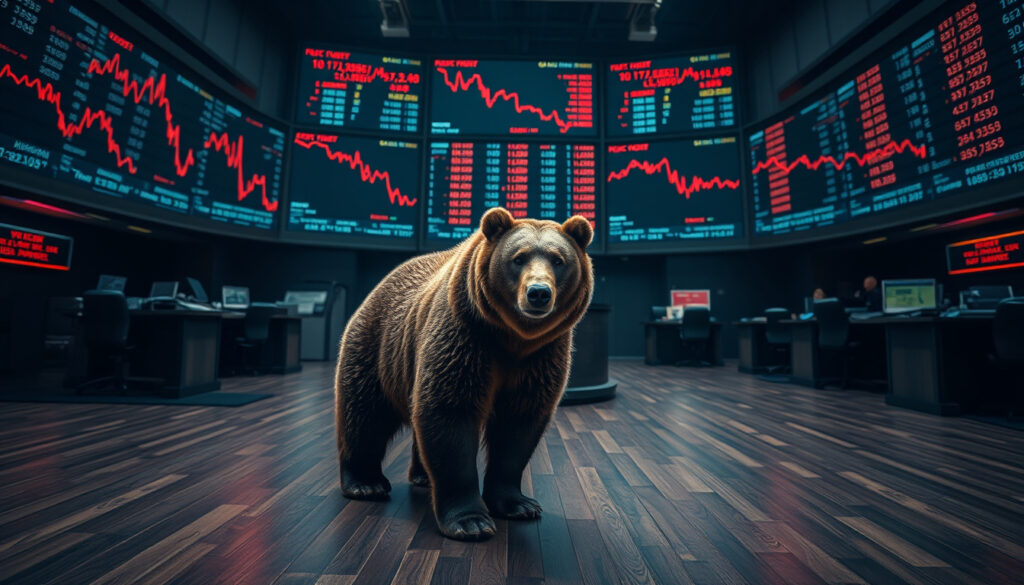
What is a Bear Market? Definition, Duration, Investing Tips
If you’ve ever watched your portfolio drop by 20% and wondered whether to sell everything or hold tight, you’ve already brushed up against the defining line of a bear market. It’s a term that gets thrown around during every downturn, but behind it lies a financial pattern that’s been repeating for nearly a century – understanding what a bear market really means can make the difference between panic and opportunity.
Average decline in a bear market: 35% from peak ·
Average duration: 289 days (9.6 months) ·
Frequency: Every 3.5 years since 1929
Quick snapshot
- Bear market defined as 20% decline over at least two months (Investor.gov (SEC))
- Average decline since 1929 is 35% (Hartford Funds)
- Average duration of 289 days (Investor.gov (SEC))
- Exact start of the next bear market (Schwab)
- Whether 2026 will be a bull or bear market (Forbes Advisor)
- Impact of geopolitical events on future declines (Investopedia)
- 1929–1932 Great Depression: 86% decline (Britannica)
- 2007–2009 Global Financial Crisis: 57% decline (Fidelity)
- 2022 Inflation bear market: 25% decline over 229 days (Morningstar)
Six key facts sum up the bear market landscape, from its strict definition to the historical frequency that investors should know.
| Fact | Value |
|---|---|
| Definition | 20% decline from recent peak over at least 2 months |
| Average decline | 35% (since 1929) |
| Average duration | 289 days |
| Frequency | Every 3.5 years |
| Worst bear market | 1929–1932, 86% decline |
| Most recent bear market | 2022, 25% decline, 229 days |
What is a bear market in simple terms?
A bear market is the financial world’s way of saying “prices are falling, and they’re falling hard.” The standard benchmark: a broad market index like the S&P 500 drops 20% or more from its most recent high, and that drop lasts at least two months (Investor.gov (U.S. Securities and Exchange Commission)). This isn’t a quick dip—it’s a prolonged period of declining prices, often accompanied by widespread pessimism about the economy.
What is a bear market example?
- The most memorable example is the 2008 Global Financial Crisis. The S&P 500 fell 57% from October 2007 to March 2009 (Fidelity).
- The dot-com crash (2000–2002) saw a 49% decline as tech stocks imploded (Britannica).
- The COVID-19 bear market of 2020 was the shortest on record, lasting only 33 days but dropping 34% (Forbes Advisor).
Why is it called bull and bear market?
The names trace back to how each animal attacks. A bear swipes its paws downward—a metaphor for falling prices. A bull thrusts its horns upward—rising prices. The analogy has been used in stock market jargon since at least the 18th century (Investopedia).
The 20% threshold is a line in the sand. Cross it, and the market is officially in bear territory—but that label alone doesn’t tell you how deep or long the pain will be.
The pattern: bear markets are defined by hard numbers, but the human reaction to them often determines an investor’s outcome.
What is a bull market vs bear market?
The two terms are opposites, but they’re also two halves of the same cycle. A bull market begins when prices rise 20% from a low and is marked by optimism and economic growth (Yahoo Finance). A bear market flips that script—pessimism, falling prices, and economic slowdown.
What is a bull market?
- Definition: A 20% rise from a recent low (measured over at least two months) (TD Canada).
- Average duration of a bull market: about 5.5 years since 1942
- Bear markets tend to be shorter but sharper—average decline of 35% versus bull market average gain of 157%
Three key differences in a compact view:
Bear markets are rougher on short-term traders, but bull markets reward patience. One pattern: every bear market eventually becomes a bull market, though the exact turning point is only visible in hindsight (Bankrate).
| Feature | Bear Market | Bull Market |
|---|---|---|
| Definition | 20% drop from recent high | 20% rise from recent low |
| Average duration | 289 days (9.6 months) | ~5.5 years |
| Average change | –35% | +157% |
| Sentiment | Pessimistic, fearful | Optimistic, confident |
Upsides of a bear market
- Lower entry prices for long-term investors (Schwab)
- Opportunity to dollar-cost average into strong stocks (Fidelity)
- Historically strong gains after bear markets end
Downsides of a bear market
- Significant portfolio losses (Investor.gov (SEC))
- Emotional stress leading to panic selling (Fidelity)
- Job losses and recession risk during severe declines (Britannica)
The implication: investors who understand the cyclical nature of bull and bear markets can plan their entry and exit points, but trying to time the switch is rarely profitable.
How long does a bear market last?
The clock on a bear market ticks for an average of 289 days—roughly 9.6 months (Hartford Funds). But averages hide extremes. The shortest bear market (2020 COVID crash) lasted just 33 days; the longest (1929–1932) stretched 2.8 years (Forbes Advisor).
How long did the 2008 bear market last?
The 2008 Global Financial Crisis bear market lasted 517 days (from October 9, 2007 to March 9, 2009) and erased 57% of the S&P 500’s value (Fidelity). It was the second-longest bear market since 1929.
Will 2026 be a bull or bear market?
No one can forecast with certainty. The market cycles every 3.5 years on average, which would place the next potential bear market around mid-2025 to late 2026 if the pattern holds. But predictions remain speculative (Forbes Advisor).
Interest rate policy, inflation, and corporate earnings are the usual triggers. A steep drop in corporate profits often precedes a bear market.
The catch: while historical averages provide comfort, each bear market is unique in duration and depth, making precise prediction impossible.
Is a bear market good or bad?
It depends on your time horizon. For short-term traders or retirees drawing down portfolios, a bear market is painful: paper losses can turn into real ones if you have to sell. But for long-term investors with a 10-year horizon, bear markets are a chance to buy quality assets at a discount (Fidelity).
Who owns 90% of the stock market?
According to Federal Reserve data, the top 10% of American households own roughly 90% of directly held stocks and mutual funds as of 2023 (Investopedia). This means a bear market’s impact is felt disproportionately by wealthy households, while retirement savers with diversified 401(k)s face a more muted effect.
For the typical retail investor, a bear market is a test of discipline—sell in fear and lock in losses, or hold and buy more. The data favors the latter over full market cycles.
Is it smart to buy during a bear market?
Buying during a bear market can be profitable if you have a long horizon and a strategy for managing the bottom. Dollar-cost averaging—investing a fixed amount at regular intervals—reduces the risk of buying at the very bottom and missing the recovery (Schwab).
Should you buy in a bear market?
- The S&P 500 has eventually recovered from every bear market in history
- Returns in the 12 months after a bear market end have averaged 24% (Fidelity)
- Waiting for the “all clear” often means missing the first weeks of a rally, which can be the strongest (Investopedia)
The trade-off for buyers: short-term pain for long-term gain, but only if you can stomach the volatility.
Historical timeline of major bear markets
- Sep 1929 – Jun 1932 — Great Depression: 86% decline (Britannica)
- Jan 1973 – Oct 1974 — Oil crisis: 48% decline (Investopedia)
- Mar 2000 – Oct 2002 — Dot-com bubble: 49% decline (Fidelity)
- Oct 2007 – Mar 2009 — Global Financial Crisis: 57% decline (Hartford Funds)
- Feb 2020 – Mar 2020 — COVID-19: 34% decline (33 days) (Forbes Advisor)
- Jan 2022 – Oct 2022 — Inflation/rate hikes: 25% decline (229 days) (Morningstar)
The pattern: every major bear market in history has been followed by a recovery, reinforcing the cyclical nature of markets.
What we know and what remains uncertain
Confirmed facts
- Bear market defined as 20% decline over at least 2 months (Investor.gov (SEC))
- Average bear market duration 289 days (Hartford Funds)
- Average decline 35% (Hartford Funds)
- Bear markets occur every 3.5 years on average (Hartford Funds)
What’s unclear
- Exact start of the next bear market (Schwab)
- Whether 2026 will be bull or bear (Forbes Advisor)
- Impact of specific geopolitical events on future bear markets (Investopedia)
- Duration of the next bear market cannot be predicted with certainty
Expert voices on the bear market cycle
A bear market is generally defined as a drop of 20% or more from a recent high in a major financial benchmark such as the S&P 500, and it’s associated with a prolonged period of falling prices and weak investor sentiment.
Britannica
Bear markets average a 35% loss and last about 9.6 months. They are part of a normal market cycle, and understanding history can help investors make strategic decisions rather than emotional ones.
Hartford Funds
A bear market is a 20% downturn from recent highs; a bull market is a 20% rise from lows. They are both natural parts of the market cycle.
Fidelity
Bear markets often have four phases: initial decline, bear market rally, secondary decline, and bottoming. Knowing these phases can help investors prepare.
Investopedia
Bear markets are a predictable feature of financial markets, not a bug. For long-term investors who can stay the course, the recovery that follows has historically more than made up for the downturn. For those nearing retirement or with a short horizon, the strategy is different: protect capital, not chase bargains. The choice between holding and buying is personal, but the data is clear—markets have always come back. For the American retail investor, the decision is simple: align your time horizon with your risk tolerance, or risk being forced to sell at the worst possible moment.
Frequently asked questions
What triggers a bear market?
Bear markets are often triggered by economic recessions, rising interest rates, financial crises, or external shocks like pandemics and geopolitical conflicts (Investopedia). A loss of investor confidence typically accelerates the decline.
How long does the average bear market last?
The average bear market since 1929 lasts 289 days (about 9.6 months) (Hartford Funds).
What should you do during a bear market?
Avoid panic selling. If you have a long time horizon, consider continuing to invest through dollar-cost averaging. Rebalance your portfolio if needed, and review your asset allocation (Schwab).
Can you make money in a bear market?
Yes, short sellers profit from falling prices, and long-term buyers can buy at lower valuations. However, making money requires either short-selling skills or patience for the eventual recovery (Fidelity).
What is the difference between a correction and a bear market?
A correction is a decline of at least 10% but less than 20% from a recent high. Bear markets start at the 20% threshold (Fidelity).
How often do bear markets occur?
Since 1929, bear markets occur on average every 3.5 years (Hartford Funds).
What is a bear market in crypto?
A crypto bear market follows the same definition: a 20% or more decline from a recent high, often lasting longer due to higher volatility. Crypto bear markets can see declines of 70-80% (Britannica).
More related posts
 Where to Watch Pacers vs Knicks: TV & Streaming Guide
 The Ballad of Wallis Island: Filming, Review, Ending
 Colombian Peso to USD: Exchange Rate & What It Buys
 2026 Social Security COLA: 2.8% Increase
 Cheap Flights to Puerto Rico from Ireland: Deals & Routes
 Best Free PDF to JPG Converters: Online Tools & Guide
 Best Queso Humacha Near Me: Authentic Bolivian Dip Guide
 Bank of America Near Me: Find Branches, ATMs & More