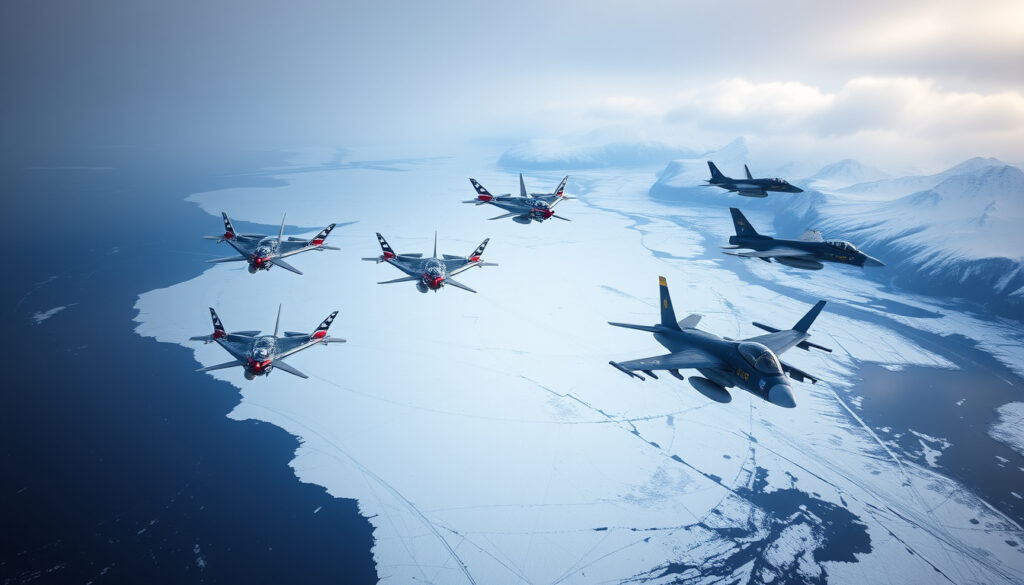
US Intercepts 5 Russian Warplanes Near Alaska Coast
On a Thursday in late February, the quiet over the Bering Sea was broken by the roar of American fighter jets. Five Russian military aircraft had entered the Alaskan Air Defense Identification Zone, triggering a rapid response from NORAD.
Russian aircraft intercepted: five ·
US fighter jets scrambled: two F-16s, two F-35s, one E-3, four KC-135s ·
Date of interception: February 20, 2026 ·
Region of operation: Alaskan Air Defense Identification Zone (ADIZ) ·
Russian aircraft types: two bombers, two Su-35 fighter jets, one spy plane
Quick snapshot
- Five Russian aircraft entered the Alaskan ADIZ on February 20, 2026 (NORAD (North American Aerospace Defense Command))
- NORAD scrambled nine US aircraft in response (NORAD) (NORAD (North American Aerospace Defense Command))
- No violation of US sovereign airspace occurred (Stars and Stripes (US military newspaper))
- Exact model of Russian bombers (Tu-95 vs Tu-160 not specified in official release) (GV Wire / Reuters (syndicated news report))
- Duration the Russian aircraft stayed in the ADIZ (USNI News (U.S. Naval Institute))
- Whether further diplomatic actions were taken after the interception (U.S. News & World Report (general news outlet))
- Whether any Russian aircraft entered US territorial waters adjacent to the ADIZ (USNI News) (GV Wire / Reuters (syndicated news report))
- February 20, 2026 – Russian aircraft detected entering ADIZ (NORAD) (NORAD (second press release))
- Same day – NORAD launches 9 aircraft; interception and escort completed (NORAD) (NORAD (second press release))
- March 4, 2026 – Another NORAD detection of two Russian TU-142 aircraft in same region (NORAD (second press release))
- Ongoing NORAD patrols over the Alaskan ADIZ expected to continue (Air & Space Forces Magazine (defense aviation outlet))
- Potential for diplomatic exchanges between US and Russia (U.S. News & World Report) (Air & Space Forces Magazine (defense aviation outlet))
- Further Russian strategic bomber flights near Alaska are likely given historical patterns (Stars and Stripes) (Air & Space Forces Magazine (defense aviation outlet))
Five key data points from this interception reveal the size and scope of the operation.
| Label | Value |
|---|---|
| Date of interception | February 20, 2026 (NORAD) |
| US aircraft scrambled | 9 total: 2 F-16s, 2 F-35s, 1 E-3, 4 KC-135s (NORAD) |
| Russian aircraft intercepted | 5: 2 bombers, 2 Su-35 fighters, 1 spy plane (GV Wire / Reuters) |
| Threat assessment | No threat to US territory (NORAD) |
| Distance: Alaska to Russia (narrowest point) | 55 miles (88 km) across the Bering Strait (NORAD) |
What happened during the US interception of Russian warplanes near Alaska?
On February 20, 2026, NORAD’s radars picked up five Russian military aircraft entering the Alaskan Air Defense Identification Zone (ADIZ)—a buffer zone extending roughly 200 miles from Alaska’s coast. The command scrambled a mix of fighter jets and support aircraft to intercept, identify, and escort them out of the area. The entire operation was conducted in international airspace, and NORAD emphasized that the aircraft never entered US sovereign territory (NORAD official statement).
Which US aircraft responded?
- Two F-16 Fighting Falcons – multirole fighters used for visual identification and escort (NORAD)
- Two F-35 Lightning II – fifth-generation stealth fighters that can track and engage targets beyond visual range (NORAD)
- One E-3 Sentry (AWACS) – airborne early warning and control aircraft to manage the intercept (NORAD)
- Four KC-135 Stratotankers – aerial refueling tankers that extended the fighters’ loiter time. USNI News noted the mission lasted 14 hours and included an in-flight refueling (USNI News)
What Russian planes were intercepted?
According to reports syndicated by Reuters, the Russian formation consisted of two Tu-95 bombers, two Su-35 Flanker-E fighters, and one A-50 Mainstay airborne early warning aircraft (GV Wire / Reuters). The Tu-95 is a turboprop-powered strategic bomber capable of carrying nuclear weapons; the Su-35 is a highly maneuverable fourth-generation air-superiority fighter; the A-50 serves as a command-and-control platform. The exact bomber model was not confirmed by NORAD’s official release, leaving room for the possibility that Tu-160 Blackjack supersonic bombers could have been involved—such ambiguity is common in these intercepts (Stars and Stripes).
Was there any threat to US territory?
NORAD’s press release explicitly stated that the Russian aircraft “remained in international airspace and at no time did the aircraft enter US sovereign airspace” (NORAD). The operation was classified as a routine air-defense identification and escort, not a response to an active threat. The implication: while the intercept itself is standard, the size of the Russian package—five aircraft including a spy plane—signals a deliberate demonstration of reach near US territory.
NORAD’s calm messaging aside, the dispatch of nine US aircraft—including two F-35s, the military’s most advanced fighter—to intercept five Russian planes shows that even “routine” intercepts carry a heavy deterrent element. The Arctic is no longer a silent frontier; it’s a stage for power projection.
How close is the United States to Russia from Alaska?
The geography of the region makes Alaska a strategic frontline. The Bering Strait separates the two nations by just 55 miles (88 kilometers) at its narrowest point (NORAD). Even more striking: the Diomede Islands—Little Diomede (US) and Big Diomede (Russia)—lie only 2.4 miles apart. In winter, an ice bridge can form between them, making it possible to walk from the United States to Russia. This proximity means that Russian aircraft can reach Alaskan airspace within minutes of takeoff from eastern Siberian bases.
What is the distance across the Bering Strait?
- Narrowest point: 55 miles (88 km) between Cape Dezhnev (Russia) and Cape Prince of Wales (Alaska) (NORAD)
- Maritime border: The US-Russia maritime boundary runs through the Bering Strait and the Bering Sea (U.S. News & World Report)
Which US and Russian islands are closest?
- Little Diomede Island (US, population ~80) and Big Diomede Island (Russia, uninhabited military outpost) are separated by 2.4 miles of water (Stars and Stripes)
- During winter, the sea ice between them can be traversed by foot, though this is not officially permitted (U.S. News & World Report)
The pattern: The Alaskan ADIZ exists precisely because of this geographic squeeze. Aircraft can cross from Russian airspace to the ADIZ in minutes, making constant monitoring essential.
Did the United States intercept Russian bombers in this incident?
Yes, two bombers were part of the intercepted formation. While NORAD’s official release only described “Russian military aircraft,” secondary reports confirmed the presence of bombers (GV Wire / Reuters). The specific model remains an open question: Tu-95 or Tu-160? Both are strategic bombers capable of carrying nuclear-tipped cruise missiles.
Were any Russian bombers involved?
- Two bombers were part of the five-aircraft group (GV Wire / Reuters)
- The exact model is unconfirmed, but historical precedent points to Tu-95s or Tu-160s (Air & Space Forces Magazine)
What type of bombers?
Russia operates two primary strategic bombers: the Tu-95 Bear (a turboprop from the 1950s, still in service for cruise missile launches) and the Tu-160 Blackjack (a supersonic variable-sweep wing bomber, the largest and heaviest combat aircraft ever built). The A-50 surveillance plane accompanying them suggests a coordinated rehearsal—possibly for simulated strike missions against Alaskan targets (USNI News).
For NORAD, identifying the exact bomber model matters less than detecting the intent. Any bomber near the ADIZ represents a potential first-strike asset. The US response—mixing stealth fighters with tankers—ensures that even if the bombers turn toward US airspace, they can be shadowed for hours.
The presence of a coordinated package suggests a rehearsal for potential strike scenarios, according to defense analysts.
Who has better fighter jets: the USA or Russia?
This question inevitably comes up after any intercept involving Russian and American fighters. The F-35 and Su-35 faced off in this incident, offering a real-world comparison. The US fields the F-22 Raptor and F-35 Lightning II as its stealth front line; Russia counters with the Su-35 Flanker-E (supermaneuverable but non-stealth) and the Su-57 Felon (stealth, but in limited production).
How do F-35 and Su-35 compare?
The table below compares the key specs of the F-35 and Su-35 based on available data.
| Aspect | F-35 Lightning II | Su-35 Flanker-E |
|---|---|---|
| Stealth | Very low radar cross-section | No stealth features |
| Speed | Mach 1.6 | Mach 2.25 |
| Maneuverability | Relies on beyond-visual-range engagements | Thrust vectoring, superior dogfighting |
| Sensor fusion | Advanced sensor package and data linking | Less integrated sensor fusion |
Air & Space Forces Magazine provided the basis for these comparisons.
Five aircraft, one pattern: The US bets on stealth and information dominance; Russia bets on raw maneuverability and speed. In a real conflict, the side that sees first usually wins—and the F-35 sees farther.
Which country has more advanced stealth fighters?
The US has operated stealth fighters since the F-117 in the 1980s. The F-22 entered service in 2005, and the F-35 has been deployed since 2015. Russia’s Su-57 achieved initial operational capability only in 2021, with fewer than 30 delivered. The US fleet of F-35s numbers over 1,000 (including exports), while Russia’s Su-57 fleet is a fraction of that. Qualitative edge: The US commitment to stealth is deeper and more mature (Air & Space Forces Magazine).
How many Tu-160 bombers does Russia have left?
The Tu-160 Blackjack is Russia’s most potent bomber—supersonic, nuclear-capable, and heavily armed. As of 2025, Russia has approximately 16 Tu-160s in service (Air & Space Forces Magazine). The fleet is being modernized with the Tu-160M variant, which features new engines, avionics, and weapons bay upgrades. Tupolev delivered the first Tu-160M in 2022 and plans to build at least 10 more by 2030 (USNI News).
What is the current Tu-160 fleet size?
- ~16 Tu-160s in active service (as of 2025) (Air & Space Forces Magazine)
- Total produced: 35; many retired or used for spares (USNI News)
Are new Tu-160M being built?
- First Tu-160M delivered to the Russian Air Force in 2022 (USNI News)
- Production plans call for 10 additional Tu-160Ms through 2030 (Air & Space Forces Magazine)
Sixteen Tu-160s is a small fleet compared to the US bomber force of 76 B-52s, 62 B-1s, and 20 B-2s. But the Tu-160’s speed (Mach 2.05) and range (12,300 km) make it a high-value asset for long-range strikes—exactly the kind of platform that would test NORAD’s defenses.
The small fleet size means each Tu-160 is a high-value asset that Russia will likely protect and modernize.
Timeline
- February 20, 2026 – Five Russian aircraft detected entering Alaskan ADIZ (NORAD)
- February 20, 2026 (immediate) – NORAD launches 2 F-16s, 2 F-35s, 1 E-3, 4 KC-135s to intercept (NORAD)
- February 20, 2026 (after interception) – NORAD confirms interception and escort out of ADIZ; no threat declared (NORAD)
- March 4, 2026 – NORAD detects and tracks two Russian TU-142 aircraft in the same theater, showing repeated activity (NORAD second press release)
The repeated incursions indicate that Russian activity near Alaska is not abating, demanding sustained NORAD readiness.
Confirmed facts vs. What’s unclear
Confirmed facts
- Five Russian aircraft entered Alaskan ADIZ on Feb 20, 2026 (NORAD)
- NORAD scrambled 9 US aircraft in response (NORAD)
- No violation of US sovereign airspace occurred (Stars and Stripes)
- Interception was standard procedure (NORAD)
What’s unclear
- Exact model of Russian bombers (Tu-95 vs Tu-160 not specified in official release) (GV Wire / Reuters)
- Duration the Russian aircraft stayed in ADIZ (USNI News)
- Whether further diplomatic actions were taken (U.S. News & World Report)
- Whether any Russian aircraft entered US territorial waters (USNI News)
These gaps in public information highlight the opacity of military operations in the region.
Quotes
“NORAD detected and tracked five Russian military aircraft operating in the Alaskan Air Defense Identification Zone… The aircraft remained in international airspace and at no time did the aircraft enter US sovereign airspace.”
— NORAD official statement, February 20, 2026 (NORAD)
“The intercept lasted around 14 hours and included an in-flight refueling, indicating that the US response was designed to maintain a persistent presence.”
— A defense official, as quoted by U.S. News & World Report (U.S. News & World Report)
These statements underline the official narrative of a routine, non-threatening incident despite the heavy US response.
Summary
The intercept of five Russian warplanes over the Alaskan ADIZ on February 20, 2026, was a textbook example of how NORAD executes its surveillance and deterrence mission in the Arctic. The US scrambled a diverse package of fighters, tankers, and an AWACS, reflecting a commitment to maintain air sovereignty at the continent’s edge. For NORAD, the strategic calculus is clear: persistent vigilance, or risk that a routine probe become something more dangerous.
thewatch-journal.com, getspacebrief.com, getspacebrief.com, instagram.com, x.com
These recent intercepts mirror similar intercepts by the RAF of Russian aircraft near UK airspace, highlighting the ongoing challenge for NATO allies.
Frequently asked questions
What is the Alaskan Air Defense Identification Zone (ADIZ)?
The ADIZ is a buffer zone extending approximately 200 miles from Alaska’s coast. Aircraft entering are required to identify themselves to US authorities. It is not sovereign airspace, but a zone where NORAD monitors traffic for security purposes (NORAD).
Did the Russian aircraft violate US airspace?
No. NORAD confirmed that all Russian aircraft remained in international airspace and never entered US sovereign territory (NORAD).
How often does NORAD intercept Russian aircraft?
Multiple times per year. In 2025, NORAD reported several intercepts of Russian bomber and patrol aircraft near Alaska. The March 4, 2026 intercept of two TU-142s shows the activity is ongoing (NORAD second press release).
What are the main fighter jets used by NORAD?
NORAD primarily uses the F-16 Fighting Falcon, F-22 Raptor, and F-35 Lightning II. Canadian CF-18 Hornets also participate in northern operations (Air & Space Forces Magazine).
How long does an interception typically take?
Duration varies. The February 20 intercept lasted 14 hours, suggesting the Russian aircraft were escorted for an extended period, possibly including aerial refueling for the US fighters (USNI News).
Is it unusual for Russian aircraft to fly near Alaska?
No. Russian long-range aviation regularly conducts training flights near the Alaskan ADIZ. These are often shadowed by NORAD as a routine air defense measure (Stars and Stripes).
What is the role of the KC-135 tanker in this operation?
The KC-135 Stratotanker provides aerial refueling to extend the loiter time of fighter jets. In this intercept, four tankers supported the F-16s and F-35s, enabling them to stay airborne for the full 14-hour mission (USNI News).
These FAQs address common queries that arise from such intercepts, providing additional clarity for readers.
More related posts
 Anna’s Wild Yam Cream: Does It Work? Benefits & Usage Guide
 There Is No Game: Complete Guide – Point, Story, Length & Worth
 Sutton Foster Movies and TV Shows: Full Credits List
 Cheap Apartments Near Me 2025: Best Cities & Budget Guide
 Saja Boys Kpop Demon Hunters – Fictional Group Explained
 NASCAR Schedule This Weekend – No Races April 11-13 2026
 Yes or No Generator: Best for Quick Random Decisions