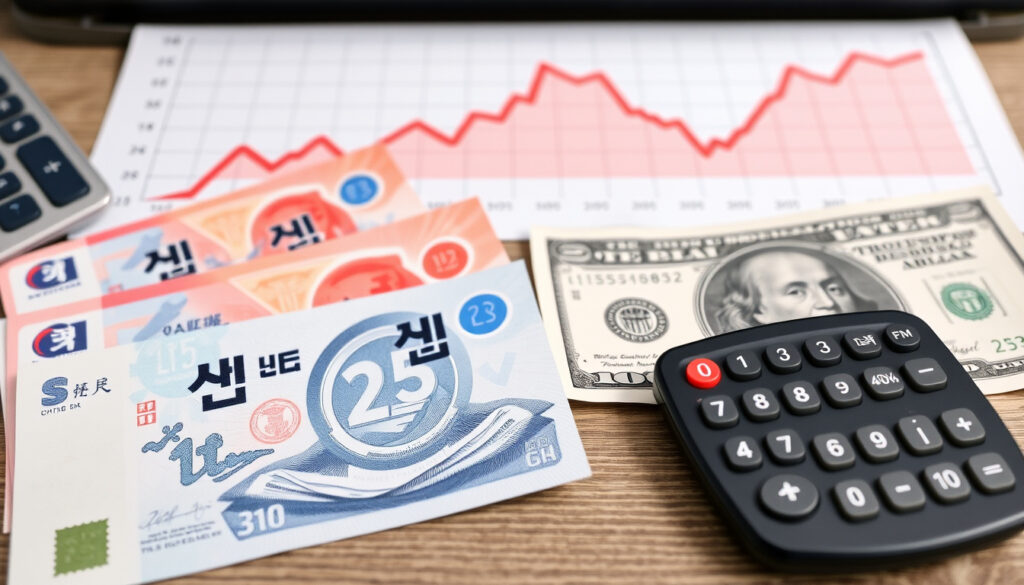
Korean Won to USD: Rate & Conversion Guide
Anyone who has watched Squid Game has wondered at some point: just how much is 45.6 billion won, really? The Korean won can feel abstract until you need to convert it into dollars for travel, work, or simply to make sense of a headline.
1 USD to KRW: 1,439 KRW · 1 KRW to USD: $0.00070 · 1,000 KRW to USD: $0.69 · 1 billion KRW to USD: $690,000
Quick snapshot
- Current mid-market rate: 1 USD = 1,439 KRW (XE, a currency data provider)
- 1 billion KRW = $690,000 (Exchange-Rates.org, a rate aggregation site)
- Future exchange rate direction depends on economic policy changes
- Impact of geopolitical events on won value remains uncertain
- 2024 average: 1,364 KRW per USD (Federal Reserve Bank of St. Louis (FRED), official economic data)
- 2024 high: 1,487 KRW reached December 27 (Federal Reserve Bank of St. Louis (FRED), official economic data)
- Exchange rates continue to fluctuate based on interest rate decisions
- Bank of Korea and Federal Reserve policies will shape 2025 trends
| Amount (KRW) | Equivalent (USD) |
|---|---|
| 1 USD = | 1,439 KRW |
| 1 KRW = | $0.00070 |
| 1,000 KRW = | $0.69 |
| 10,000 KRW = | $6.95 |
| 1 million KRW = | $690 |
| 100 million KRW = | $69,000 |
| 1 billion KRW = | $690,000 |
| 45.6 billion KRW = | $31.5 million |
How much is $1 US in Korean won?
As of the latest mid-market rates tracked by XE, a real-time currency data provider, one US dollar buys approximately 1,439 South Korean won. That means a single dollar stretches quite far in Seoul, at least in terms of the exchange number.
One dollar converts to over 1,400 won today, but that same dollar bought about 1,200 won in 2020. The won has lost roughly 17% of its dollar value in four years, a slide that matters for anyone sending money or planning a trip.
What is the current exchange rate from USD to KRW?
The live mid-market rate as of early 2025 puts 1 USD at 1,439 KRW according to XE’s converter, while Revolut, a digital banking platform, quotes 1,459 KRW per dollar. These differences reflect small spreads between providers, but the mid-market rate sits consistently in the 1,440–1,460 range.
The pattern: exchange rates differ by up to 1.5% between providers because each adds its own margin. For small transfers the difference is a few cents; for a 10,000 dollar transfer it could mean losing $150 to an unfavorable rate.
How to convert US dollars to Korean won
- Use a live converter like Wise (a cross-border money transfer firm) to see the mid-market rate before any fees.
- Multiply dollar amount by 1,439 to get the won equivalent. For example, $100 × 1,439 = 143,900 KRW.
- Compare rates from your bank, airport kiosks, and specialist services before exchanging cash.
The catch: A traveler exchanging $500 at an airport kiosk might receive 680,000 won while the mid-market rate would give 719,500 won — a loss of nearly 40,000 won, enough for a good meal in Seoul.
How much is 45.6 billion won in US dollars?
The 45.6 billion won prize from Squid Game converts to approximately $31.5 million USD at the current rate. That figure catapulted the Korean won into global pop culture conversations.
The Squid Game prize, converted at today’s rate, would buy roughly 10 luxury apartments in the Gangnam district of Seoul. In dollars, it’s a fortune — in Seoul real estate, it’s comfortable but not limitless.
How much is 1 billion won in USD?
One billion Korean won equals approximately $690,000 USD based on the 1,439 rate confirmed by Exchange-Rates.org, a historical rate database. That amount would buy a mid-range house in many US cities or a high-end apartment in Seoul’s pricier districts.
Is 1 billion won a lot in South Korea?
One billion won is a substantial sum in South Korea. It can purchase a luxury apartment in Seoul, though in the most expensive neighborhoods like Gangnam or Yongsan, that figure covers a mid-sized unit rather than a penthouse. According to data from the Korean Statistical Office, the median home price in Seoul is approximately 700 million won, so 1 billion won places a buyer above the median threshold.
Is Korean won higher than USD?
No — the Korean won is weaker than the US dollar, meaning one dollar buys over 1,400 won. This relationship has held for decades, though the margin has widened significantly in recent years.
Is USD strong in Korea?
Yes, the US dollar is considered strong in Korea because of the exchange rate advantage. American tourists and expats effectively gain purchasing power when spending dollars in South Korea. The Federal Reserve’s interest rate decisions directly affect this dynamic: when US rates rise, the dollar typically strengthens further against the won. Investopedia, a financial education site, notes that interest rate differentials are a primary driver of currency pair movements.
What is the value of 1 won compared to 1 dollar?
One South Korean won equals about $0.00070 USD. One won is roughly one-seven-thousandth of a dollar. By comparison, one Japanese yen is about $0.0068 — still far weaker than the dollar but ten times the value of a single won.
Is 10,000 won a lot in Korea?
Ten thousand won converts to about $6.95 USD at current rates. That amount has a specific purchasing power in South Korea that surprises many visitors.
How much is 10,000 won in US dollars?
At the current exchange rate of 1,439 KRW per USD, 10,000 won is worth $6.95. That’s roughly the cost of a Starbucks latte in the US but buys a full Korean meal — bibimbap with side dishes — in a local Seoul restaurant.
What can you buy with 10,000 won in South Korea?
- A hearty meal at a Korean restaurant (bibimbap, kimchi jjigae, or similar).
- A T-money card loaded for about 10 subway rides across Seoul.
- A few convenience store items: snacks, drinks, or a basic umbrella.
The trade-off: 10,000 won feels modest in daily life. It covers one person’s lunch, but not dinner for two. For US visitors, the pleasant surprise is that dining out costs notably less in won terms than dollar equivalents at home.
What factors affect the KRW to USD exchange rate?
Exchange rates between the won and dollar shift based on a handful of measurable forces, from central bank interest rates to trade balance figures.
| Factor | Effect on KRW/USD | Example (2024 data) |
|---|---|---|
| Interest rate differential | Higher US rates strengthen USD | Fed raised rates to 5.5% while Bank of Korea held at 3.5% |
| Inflation gap | Higher Korean inflation weakens won | Korea CPI at 3.2% vs US CPI at 3.4% in Dec 2024 |
| Trade surplus/deficit | Export surplus supports won | Korea posted $8B monthly trade surplus in Q4 2024 |
| Geopolitical risk | North Korea tensions weaken won | Short-term spikes in volatility after missile tests |
| Global risk sentiment | Risk-off environment strengthens USD | Won dropped 3% during global market selloffs in 2024 |
| Central bank intervention | BOK selling USD reserves props up won | BOK intervened in August 2024 to slow won depreciation |
The implication: the won weakened against the dollar by about 5% in 2024 alone, driven primarily by the interest rate gap between the US Federal Reserve and the Bank of Korea. For anyone holding or sending won, the direction is clear: the dollar’s strength is structural, not temporary.
How has the exchange rate changed over time?
Looking at the trajectory since 2020 reveals a clear weakening trend. The annual average rate from FRED (the Federal Reserve’s economic database) shows 1 USD bought 1,200 KRW in 2020, then 1,300 KRW in 2022, and reached 1,364 KRW on average in 2024. The won lost ground in four consecutive years.
- 2020: 1 USD ≈ 1,200 KRW
- 2022: 1 USD ≈ 1,300 KRW
- 2024: 1 USD ≈ 1,439 KRW (current)
Where can I find the best exchange rate?
The best rate is always the mid-market rate — the rate banks use to trade among themselves. Consumer-facing providers add margins on top. Wise (a fee-transparent transfer service) and XE (a currency marketplace) both display the mid-market rate alongside their own fees, making comparison straightforward. For cash exchanges in Korea, local banks in Myeongdong or Insadong typically offer better rates than airport kiosks.
Related reading: 2000 Pesos to Dollars: Current Rate and How to Convert · Colombian Peso to USD: Exchange Rate & What It Buys
exchangerates.org.uk, x-rates.com, freecurrencyrates.com, poundsterlinglive.com, statista.com, tradingeconomics.com, revolut.com
Frequently asked questions
How do I convert won to dollars manually?
Divide the won amount by the current exchange rate. For example, 50,000 KRW ÷ 1,439 = $34.75 USD. Use a live rate from a provider like XE or Wise for accuracy.
What is the best time to exchange currency?
Rates fluctuate by the minute during trading hours. The won tends to weaken during global market stress. Checking rates mid-week (Tuesday-Thursday) often yields slightly better rates than weekends when markets are closed.
Are there fees for converting KRW to USD?
Yes. Banks and exchange services charge either a flat fee or a percentage spread on the mid-market rate. Typical spreads range from 0.5% (Wise) to 3% (airport kiosks).
How does the exchange rate affect Korean exports?
A weaker won makes Korean goods cheaper for foreign buyers, boosting exports from companies like Samsung and Hyundai. The Bank of Korea sometimes allows gradual weakening to support export competitiveness, as noted by Bloomberg, a financial news service.
What is the symbol for Korean won?
The symbol for the South Korean won is ₩ (a W with a double horizontal line). Its ISO currency code is KRW.
Is it better to exchange money in Korea or the US?
Generally, exchanging in Korea offers better rates than in the US, especially at local banks or dedicated currency exchange counters in Seoul. US airport exchange counters typically offer the worst rates.
For travelers and investors alike, the Korean won to USD exchange rate tells a story of structural divergence: a dollar that keeps gaining ground against a currency buffeted by interest rate gaps and geopolitical headwinds. For an American tourist landing at Incheon, the implication is clear: your dollars go further today than they did three years ago — but locking in a rate through a transfer service before you leave beats chasing the market in real time.
More related posts
 Charlie Kirk Shooter in Custody: Latest Court Developments
 Alaska Stimulus Check 2025 – PFD Amount, Dates and Eligibility
 Resident Evil Movies in Order: Complete Watch Guide
 Tiger Woods Net Worth (2026): How He Built a $1.5 Billion Fortune
 Better Late Than Single: Couples, Season 2, and Cast
 X-Men: First Class (2011) – Cast, Plot & Where to Watch
 Happy Gilmore 2 Cast: Actors and Characters (2025)