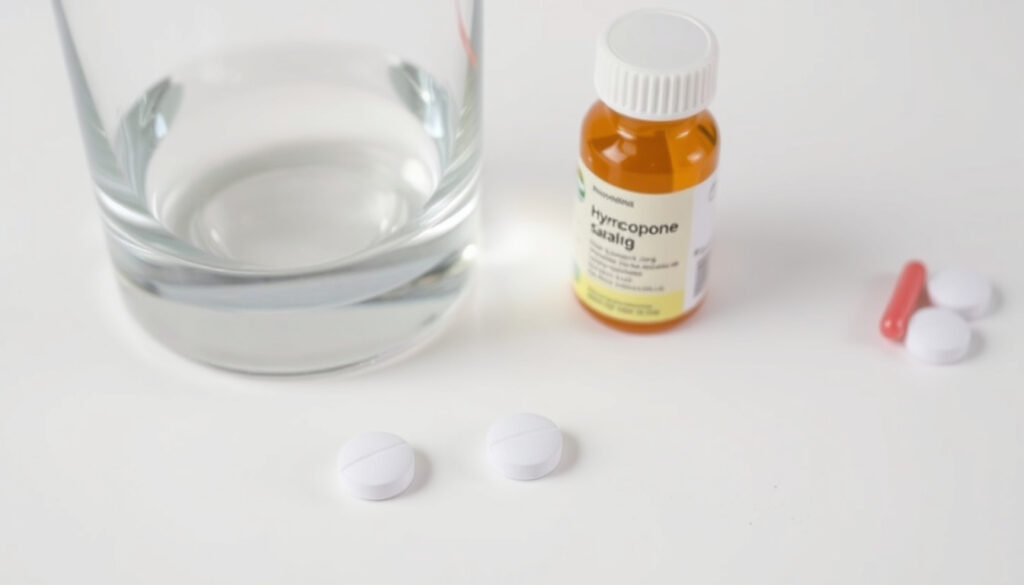
Hydrocodone Acetaminophen 5-325: Dosage, Side Effects & Comparisons
Hydrocodone/acetaminophen 5-325 remains a go-to prescription for moderate pain, yet its acetaminophen component sets a strict ceiling that limits opioid escalation. Few things are as universal as needing relief from moderate pain—whether from a dental procedure, injury, or post-surgery recovery—and this combination has been a mainstay for decades.
Common brand names: Norco, Vicodin, Lortab, Lorcet · Active ingredients: Hydrocodone bitartrate 5 mg + Acetaminophen 325 mg · Typical adult dose: 1–2 tablets every 4–6 hours as needed · Maximum acetaminophen per day: 4,000 mg (12 tablets of 5-325) · Controlled substance schedule: Schedule II (DEA)
Quick snapshot
- Standard combination tablet: 5 mg hydrocodone + 325 mg acetaminophen (DailyMed (NIH drug database))
- Hydrocodone is an opioid mu-receptor agonist (FDA prescribing information)
- Maximum daily acetaminophen: 4,000 mg to avoid liver toxicity (MedlinePlus (NIH consumer health))
- Exact onset time can vary by individual metabolism and stomach contents
- Subjective feelings of euphoria or drowsiness are patient- and dose-dependent
- Relative abuse potential compared to other opioids in real-world use is debated
- Onset of pain relief: 30–60 minutes after oral dose (DailyMed (NIH drug database))
- Peak effect at 1–2 hours; duration 4–6 hours (DailyMed (NIH drug database))
- Half-life: hydrocodone 3.8–4.5 hours; acetaminophen 2–3 hours (DailyMed (NIH drug database))
- Use lowest effective dose for shortest duration (U.S. FDA guidance)
- Do not combine with alcohol or other CNS depressants (U.S. FDA guidance)
- Monitor for signs of respiratory depression or dependence (U.S. FDA guidance)
The key facts at a glance:
| Attribute | Value |
|---|---|
| Brand Names | Norco, Vicodin, Lortab, Lorcet |
| Dosage Form | Tablet |
| Route of Administration | Oral |
| DEA Schedule | II |
| Half-Life | Hydrocodone 3.8–4.5 hours; Acetaminophen 2–3 hours |
| Pregnancy Category | C (risk not ruled out) |
Is Hydrocodone Acetaminophen 5-325 a Strong Pain Killer?
How painkiller strength is classified
Painkiller potency is typically measured using morphine milligram equivalents (MME). The 5 mg dose of hydrocodone is considered low to moderate on the opioid spectrum. According to the FDA prescribing information, hydrocodone/acetaminophen products are indicated for “moderate to moderately severe pain.” The addition of acetaminophen enhances pain relief through a different mechanism, making the combination more effective than either drug alone for many patients.
Comparing 5 mg hydrocodone to other opioids
On a milligram basis, 5 mg of hydrocodone is roughly equivalent to 5 mg of morphine, but its oral bioavailability is higher, giving it comparable analgesic effect. For reference, a review in PubMed confirms that hydrocodone is more potent than codeine. However, a randomized trial in Academic Emergency Medicine (Wiley) found that hydrocodone/acetaminophen 5/500 did not provide clinically superior pain relief compared with codeine/acetaminophen for acute extremity pain—suggesting real-world equivalence in some contexts.
The pattern: This low-to-moderate combination works well for its intended use but is not a high-potency option.
How Long Does It Take for Hydrocodone Acetaminophen 5-325 to Kick In?
Typical onset time after oral administration
After swallowing a tablet, the drug must be absorbed through the gastrointestinal tract. DailyMed (NIH drug database) states that peak plasma concentrations of hydrocodone occur about 1.3 hours after dosing. Most patients report noticeable pain relief within 30 to 60 minutes, with the maximum effect felt between 1 and 2 hours.
Factors that influence onset (food, metabolism)
Taking the tablet with a high-fat meal can delay absorption, meaning it may take longer to feel the effects. MedlinePlus advises that individual metabolism—especially liver function and genetics—also plays a role. The duration of action is 4 to 6 hours, after which the pain may return and another dose can be considered if due.
The trade-off: Faster absorption on an empty stomach can lead to a more intense initial effect, but it also increases the risk of side effects like nausea.
Can I Take Two Hydrocodone Acetaminophen 5-325 Tablets at Once?
Recommended dosing schedule
The typical adult dose is 1 or 2 tablets every 4 to 6 hours as needed for pain, according to FDA prescribing information. Taking two tablets at once is within the recommended range for patients with higher pain levels, but the key limit is the total daily amount of acetaminophen.
Risks of exceeding recommended doses
Each 5-325 tablet contains 325 mg of acetaminophen. Because the standard maximum daily acetaminophen dose is 4,000 mg (MedlinePlus (NIH consumer health)), that means no more than 12 tablets in 24 hours. Taking more risks liver damage—this is the factor that often limits opioid dose escalation. The DailyMed labeling warns: “Do not exceed 4,000 mg of acetaminophen per day.”
The implication: The acetaminophen ceiling, not the opioid, is the dose-limiting factor for 5-325. If your pain requires more than 2 tablets per dose or 12 per day, talk to your doctor about a different formulation.
How Does Hydrocodone 5-325 Make You Feel?
Common subjective effects (euphoria, drowsiness)
Many patients report a sense of relaxation, well-being, or mild euphoria shortly after taking the drug. PubMed research notes that opioids act on the brain’s reward system, which contributes to both the analgesic effect and the potential for misuse. Drowsiness is also very common. The FDA labels list sedation as a frequent adverse effect, which can increase the risk of falls, especially in older adults.
Side effects: nausea, dizziness, constipation
Nausea and vomiting occur in a significant number of users, particularly when starting the medication. Constipation is almost universal with prolonged opioid use. Cleveland Clinic (health system) explains that the combination works by blocking pain signals in the brain, but it also slows gastrointestinal motility. Staying hydrated and using stool softeners can help.
- Drowsiness: affects daily activities like driving
- Dizziness: may cause lightheadedness upon standing
- Constipation: manage with fiber and fluids
Patients who need to drive or operate machinery should be especially cautious. The sedative effect is dose-dependent and can be amplified by other medications or alcohol.
The pattern: These effects are typical of opioids and require careful management.
Is Hydrocodone Stronger than Codeine?
Pharmacological differences between hydrocodone and codeine
Hydrocodone and codeine are both opioid agonists, but they differ in how they are processed by the body. Codeine is a prodrug that must be converted to morphine via the CYP2D6 enzyme—meaning people with certain genetic variations may get little or no pain relief. Hydrocodone is an active drug itself and does not require metabolic activation. A pharmacology review in PubMed states that hydrocodone is approximately 1.5 to 2 times more potent than codeine on a milligram basis.
Equivalent dose comparisons
Clinically, 5 mg of hydrocodone is often considered equivalent to about 30 mg of codeine in analgesic effect. However, a head-to-head trial of hydrocodone/acetaminophen 5/500 vs codeine/acetaminophen showed no significant difference in pain scores (Academic Emergency Medicine (Wiley)), so the real-world difference may be small for acute pain.
The pattern: Codeine’s variable metabolism makes it less reliable, while hydrocodone offers more predictable effects. Both are Schedule II controlled substances according to the DEA Drug Scheduling.
Comparison table: hydrocodone 5-325 vs codeine — five key differences, one clear trade-off.
| Attribute | Hydrocodone 5-325 | Codeine (with acetaminophen) |
|---|---|---|
| Potency (per mg) | 1.5–2× codeine (PubMed) | Baseline |
| Metabolic activation | Active drug, no CYP2D6 needed | Prodrug, requires CYP2D6 (MedlinePlus) |
| Typical onset | 30–60 min (DailyMed) | 30–60 min |
| Common side effects | Drowsiness, constipation, nausea | Drowsiness, constipation, nausea |
| DEA schedule | II (DEA) | II, III, or V depending on dose (DEA) |
Spec table: detailed specs of hydrocodone acetaminophen 5-325 — 7 parameters, one notable pattern.
| Parameter | Value |
|---|---|
| Active ingredients | Hydrocodone bitartrate 5 mg + Acetaminophen 325 mg |
| Dosage form | Oral tablet |
| Bioavailability | Hydrocodone ~70% |
| Protein binding | Hydrocodone ~20% |
| Metabolism | Liver (CYP3A4, CYP2D6) |
| Elimination half-life | Hydrocodone 3.8–4.5 h; Acetaminophen 2–3 h |
| Renal excretion | Hydrocodone primarily renal |
The takeaway: The spec data confirm that this formulation is designed for short-term use with a predictable pharmacokinetic profile.
How to Take Hydrocodone Acetaminophen 5-325 Safely
- Step 1: Take exactly as prescribed. The usual starting dose is 1 tablet every 4–6 hours. If pain is not controlled, your doctor may authorize 2 tablets per dose.
- Step 2: Track your total acetaminophen intake from all sources. Check OTC cold and flu medicines—many contain acetaminophen.
- Step 3: Avoid alcohol entirely. Combining alcohol with acetaminophen increases liver toxicity and adds CNS depression.
- Step 4: Do not drive or operate heavy machinery until you know how the medication affects you. Drowsiness can be significant.
- Step 5: Dispose of unused tablets properly—take-back programs are recommended by the U.S. FDA.
These steps reflect standard medical advice. Always consult your prescribing physician for personalized guidance.
Patients who follow these steps can reduce the risk of serious adverse events.
What We Know and What Remains Unclear
Confirmed facts
- Hydrocodone 5 mg + acetaminophen 325 mg is a standard FDA-labeled combination (DailyMed)
- Maximum daily acetaminophen is 4,000 mg to avoid liver toxicity (MedlinePlus)
- Hydrocodone is an opioid mu-receptor agonist (FDA)
What’s unclear
- Exact onset time varies by individual metabolism and stomach contents
- Subjective feelings of euphoria or drowsiness are patient- and dose-dependent
- Relative abuse potential compared to other opioids in real-world use is debated
The distinction between confirmed and unclear helps clinicians and patients set realistic expectations.
“This combination works by blocking pain signals to the brain.”
“Hydrocodone is a semi-synthetic opioid with antitussive and analgesic properties.”
“Norco 5/325 tablets: 1 or 2 tablets every 4 to 6 hours as needed.”
FDA prescribing information
The consequence for patients is clear: hydrocodone acetaminophen 5-325 remains a valuable tool for moderate pain, but its use demands strict respect for acetaminophen limits and awareness of opioid risks. For those seeking an alternative with more predictable metabolism, hydrocodone offers advantages over codeine. For the prescribing clinician, the choice hinges on balancing efficacy, safety, and patient-specific factors such as liver function and history of substance use. The trade-off is straightforward: reliable pain relief with a low dose of opioid, boxed by the very real dangers of dependence and liver damage.
anrclinic.com, orlandorecovery.com, medicalnewstoday.com, healthline.com, goodrx.com, bicyclehealth.com
Frequently asked questions
What should I avoid while taking hydrocodone 5-325?
Avoid alcohol, other CNS depressants (benzodiazepines, sleeping pills), and any additional acetaminophen-containing products. Also avoid driving until you know how the drug affects you.
Can I take hydrocodone 5-325 with ibuprofen?
Yes, in many cases ibuprofen can be taken concurrently, but consult your doctor first. Combining NSAIDs with opioids may increase the risk of gastrointestinal bleeding.
Is it safe to drive after taking hydrocodone 5-325?
No, not until you know your reaction. Drowsiness, dizziness, and slowed reaction times are common and can impair driving ability.
How long does hydrocodone 5-325 stay in your system?
Hydrocodone has a half-life of about 4 hours, but detectable levels can remain in urine for 2–4 days after last use, depending on metabolism.
What are the signs of an overdose?
Signs include extreme drowsiness, slow or shallow breathing, pinpoint pupils, and loss of consciousness. Seek emergency medical help immediately.
Can I stop taking hydrocodone 5-325 abruptly?
Stopping suddenly after prolonged use can cause withdrawal symptoms. Tapering under medical supervision is recommended.
Does hydrocodone 5-325 interact with antidepressants?
Yes, especially SSRIs and SNRIs—combined use can increase the risk of serotonin syndrome. Discuss all medications with your doctor.
Related reading
- Folate vs Folic Acid: Differences, Benefits and Recommendations – a pharmaceutical comparison guide
- Cramps But No Period: 8 Causes and Red Flags – health context for pain that may require treatment
More related posts
 Savannah Guthrie Brother-in-Law: False Accusations Explained
 Tom Ford Ombré Leather – In-Depth Review and Performance Guide
 Is Caitlin Clark Transgender – Facts and Rumors Debunked
 Unblocked Games Premium 77: Verified Guide & Facts
 ASAP Rocky Net Worth vs Rihanna: 2025 Comparison
 What Is an Adverb? Definition, Types and Examples – Grammar Guide
 Bank of America Near Me: Find Branches, ATMs & More